Beverley Little, Contributor
Little
Like all fully colonised British territories, the Jamaican education system has had it roots in the traditional British education system, which has historically been punitive and elitist, emphasising and maintaining social divisions and inequalities instead of unity and equity. Whether deliberately or otherwise, Jamaican schools have, somehow, successfully allowed us as Jamaicans to focus on our differences in terms of skin colour, social backgrounds, needs, achievements, incomes, socialisation processes, and even our religious and political preferences. They, like their British counterparts, have been agents of social control rather than agents of social transformation.
Admittedly, education in Jamaica, like in most places, has been a vehicle of social mobility. Yet, despite this, the system has failed to live up to our expectations and has not delivered what we hoped it would during independence.
Governments over the years, in recognising the shortcomings of the system and the role education needs to play in sustainable national development, have of educational goals and the overall expansion of the education system.
objectives
This was followed in 1966 by the New Deal in Education in Independent Jamaica. Its objectives were: to provide compulsory free education to all youths up to age 14; to expand and improve secondary and higher education; to improve the planning and administration of education.
The objectives of the New Deal in Education, as it came to be known, were only partially achieved when the government changed in 1972. After just over a year in office the new government declared itself democratic socialist and sought to bring the education system in line to reflect its ideological position. This gave birth to the Education Thrust of the Seventies. Its purpose, as stated in the document, was to "develop effective educational programmes, so that young people can serve the needs of their communities and the nation, and at the same time their own need for better levels of living".
major initiatives
This translated into four major initiatives: the introduction of free education at all levels of the government education system; the conversion of junior secondary to new secondary schools with the expansion of their curriculum from three to five years; the introduction of the double shift system, and the introduction of the National Youth Service.
This was accompanied by a plethora of anti-colonialism and anti-imperialism rhetoric with much ado about the need for equality of educational opportunities. As usual, it promised more than it delivered. By the end of the 1970s the Jamaican education system still resembled the inherited British model. By and large, the adjustments were similar to those in the decade before, mere band-aids, nothing structural or substantial had changed. Our secondary school system, for example, remained just as multi-tiered as before.
powerful interests
Even today, after 46 years of independence, the British education model remains firmly rooted and grounded not only in the Jamaican education system, but also in the psyche of many of our people. Its longevity is perhaps attributable to the fact that there are some important powerful interests in our society who, despite often espousing anti-colonialism sentiments, continue to swear by the merits of a British-type education, particularly its grammar school and university education. Many consider it superior and sacred, and so it has become the standard by which all other education systems are judged. Hence, the retention of an outdated, inappropriate, divisive system of education that glamorises one set of schools and stigmatises another.
On July 22, this year, for example, in a discussion in Parliament about education, one member of the House of Representatives, in his contribution quickly and proudly announced that he had attended a 'traditional high school'. Obviously, this distinction is important, lest we mistakenly conclude that, he being so accomplished, may have been the unfortunate beneficiary of a 'lesser' education. The distinction is continuously being made between 'traditional' and 'new' high schools. These labels merely serve to reinforce the class distinctions in our society, which our school system continues to perpetuate.
This partially explains why so many parents fork out enormous sums of money on elementary education, sending their offspring to expensive preparatory schools and The distinction is continuously being made between 'traditional' and 'new' high schools. These labels merely serve to reinforce the class distinctions in our society.
on extra lessons, so that they are awarded places in the 'best' schools, translated 'traditional high schools'.
contentious gsat
Consequently, the GSAT remains as contentious as its predecessor, the 11+ Common Entrance Examination. It should be noted that it is not the content or format of a test that determines its type, but the purpose for which it is used. And the GSAT, like the 11+, is a placement examination despite its name. Nothing has really changed.
We are currently in the midst of another transformation which has been in gestation for the last four years. The current minister of education has promised to 'deliver the transformation baby' which its parents claimed were conceived on the principle that 'each child can learn, every child must learn'.
This transformation process is not peculiar to Jamaica, and is part of a worldwide trend of public sector reform/modernisation which, interestingly, began in Great Britain in the 1980s under Margaret Thatcher's leadership. The process has sought to change the civil service from a unified structure into separate relatively autonomous entities responsible through their parent ministries or ministers for the delivery of public services.
The reforms have been comprehensive, transforming public management and accountability by separating policy formulation from service delivery. The major difference between this transformation and previous ones, apart from its British origin, is that the change starts at the top, with the Ministry of Education, and is expected to filter down through the system.
transformation
Given the unsuccessful, piecemeal attempts of the past, it is my wish that this transformation will actually mean what the current minister of education calls 'real change'. Real change must involve removing from the education system those barriers which continue to divide us as a people. We must create a level playing field for all learners. There is absolutely no justification for so many different types of secondary schools. We need to recognise and acknowledge that some things should not be sacrosanct, and it is time to get rid of the 'traditional high school' label and mentality.
What we need is a Common School which, R.N. Murray (former Senior Education Planner, Ministry of Education ) argued, several years ago, does not imply that all the pupils in the school are aiming at identical places in society, but that this school would provide a wide range of opportunities for pupils to self-develop.
equal access
Real change must ensure that every child in this country has equal access to all educational opportunities. That a child living in the inner city or deep rural Jamaica is not disadvantaged by the education system because of the circumstances of his/her birth, socio-economic status, or geographical location. The school system must provide for every child broad, challenging curricula, adequate resources, effective leadership, de-stigmatised, respected schools and qualified, committed, passionate, caring teachers.
Schools must foster integration rather than discrimination, so that we can learn to live together as one people and give real meaning to our motto, Out of Many One People. Then we would have cause to celebrate our independence from Britain, which promised so much in 1962.
Real meaningful change requires, among other things vision, commitment and will - political will. If the Jamaican education system is to become a transformed and transformative force, then political mechanisms which may prove unpopular may have to be implemented. So far education decision makers have seemed unwilling to take that risk. After 46 years of independence do we dare to hope?
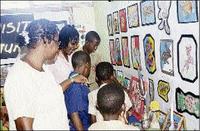
Children from the Southborough Primary School view artwork done by students of Bridgeport High during a display by several Portmore Schools at Southborough to mark Education Day.
Beverley Little is an educator who has worked in Jamaica and Botswana. She holds a master's degree in public sector management and may be contacted at bvl18@hotmail.com. Feedback may also be sent to columns@gleanerjm.com.


















