
These early days of August, as we mark the anniversary of our independence, serve to direct us to the thinking that within 48 months, the 50th milestone will be upon us.
The celebration of 50 years in the journey of any person, place or thing is an occasion of moment. In the case of the human being, there is reason to ponder achievements and, appropriately, to contemplate any work in progress that is meant to sustain further steps along the journey.
In the case of a country, there are far wider areas of contemplation, since the span of the journey outstrips that of the person timelessly.
So, the real significance of half a century along Jamaica's journey, as a sovereign state, lies in the requirement that we seize the moment of a signal milestone to contemplate several sustaining inputs stretching from what is near to what is distant.
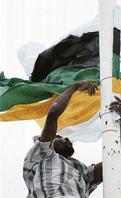
A workman puts up the national colours on one of the many flagpoles at the National Stadium, in St Andrew, in preparation for the August 6 Independence Day Parade and Grand Gala. - Ricardo Makyn/Staff Photographer
Retaining the monarchy
Inasmuch, then, as we are obliged to scrutinise the developmental balance sheet covering these past 46 years, it is equally prudent that we seek, within the next four years, to remove from the debit side several items that ought not to be reflected in an independent state in the 21st century. And, certainly, not after it would have flown its own flag for 50 years!
An item which should, by then, have been removed from the balance sheet altogether - and there are those among us who place it on the credit side - is our retention of the British monarch as the symbol of our head of state.
The retentionists do not appear even to be fazed by the oddity of the citizens of a sovereign state, Jamaica, having to obtain a pass in the form of a visa to enter the country of residence of their head of state.
It is clear that the agreed convenience of clinging to the apron strings of the erstwhile imperial power in this fashion was not meant to have lasted for such a long time, and certainly not to the extent that the finger-tip cling to this string became as tenuous as it now is.
And what is more, political games have been played around this type of issue which should serve to lead Jamaicans to the conclusion that moving away from the monarchy signals a willingness to stand on our own feet in our own sovereign sphere of influence.
presidential system
For example, in 1995, Bruce Golding, the present prime minister, gave as a reason for walking away from the Jamaica Labour Party (JLP) the concern that a joint select committee of Parliament, having deliberated on the reform of our independence constitution, had failed to give enough consideration to the adoption of an executive presidential system as obtains in the United States of America.
He complained that that was his preferred position - that the president should be elected by means of a direct vote by the people - and proceeded to champion that cause, with the separation of powers template, in his newly formed National Democratic Movement.
The truth is that the committee, of which he himself was a member, had considered that model, which was itself the position traditionally held by the People's National Party (PNP). Both the then governing PNP and the opposition JLP agreed in the joint select committee that the immediate imperative was for Jamaica to move away from the monarchy and thus arrived at a compromise approach of pursuing the model of a ceremonial presidential system.
Golding, after some seven years, re-entered the JLP and, under his leadership, we came to witness in that party's 2007 manifesto the very first pledge: "Take steps to amend the Constitution to replace the Queen with a Jamaican president who symbolises the unity of the nation. Such a president will be appointed by consensus through a two-thirds majority vote in each House of Parliament."
But then, that is the very position that had been agreed in 1995, save only that the joint select committee had also put the alternative view of the PNP. This was that, as a signal of unity, such a two-thirds majority vote in Parliament for the appointment of the ceremonial president should take place with both Houses sitting together. So we wasted 12 years, 1995 to 2007. And, of late, we have not been receiving any further signal on that political game.
For my part, Jamaican athletes ought not to be present at the Olympics in 2012, with their country being one of the very few sovereign states of the world which finds itself in this odd constitutional position of having a foreign head of state.
There is the requirement, also, that, before our 50th anniversary as an independent country, we would have moved to place our party political construct on a more wholesome footing.
Address partisanship
There has to be a real lessening of partisan political tendencies and a settled way of dealing with the funding of political parties and campaign financing.
The dangerous consequences of what can flow from these activities, if left unbridled, are inextricably bound together.
We have gone a fair distance along the road of integrity in our electoral processes, particularly, in relation to national election exercises. We must now move with speed to address partisanship, which breeds victimisation and to adopt measures which would prevent our political parties from being owned and directed by special interests.
Victimisation, in any circumstance, in any country, serves as a debilitating instrument.
In our case, here in Jamaica, we are not blessed with the kind of riches in our human resource content as to be able to withstand the harsh results of a partisan and tribal approach to employment and to other opportunities to which our people are entitled. This is a real challenge to our democracy.
The consequences of a failure to address in a meaningful way and to settle on transparent means of the funding of political parties and political campaigns speak for themselves, particularly in this age of the 'anything-goes' approach to the accumulation of wealth.
Party funding
For peace in our political process to be realised, and to reign, the funding of political parties cannot continue for much longer to remain a secret.
There is the imperative that, by 2012, we would have removed all impediments and we would have witnessed the abolition of appeals to the judicial committee of the Privy Council in London, England. We note that this initiative does not form part of the 2007 manifesto projections of the present administration.
With all due respect to our sister Commonwealth countries, such as Vanuatu and the Republic of Kiribati, Jamaica must surely prefer to be grouped with the overwhelming majority of countries on the planet that do not have a final court of appeal which sits on foreign soil.
Foreign court
At least, in the case of the Caribbean Court of Justice (CCJ), the intention is that that final court will sit in Jamaica whenever it is to hear appeals from our own local court of appeal.
There are persons in leadership positions and otherwise who remain steadfast in the view that having the Privy Council as our final court of appeal holds certain advantages for Jamaica's development. Such advantages have not been spelt out in such a way as to inform our citizens meaningfully.
In any event, again, it is certainly difficult to explain to the interested bystander how it has come to pass that access, by lawyer or petitioner, to the place where our final court is sited is obtained by means of a visa. And, lest we forget, we continue to pay Jamaica's required share for the management of the CCJ.
Half a century is surely a long time for a people of a sovereign state to conclude that they have the required confidence that they can be judged, and judged fairly, by their own kith and kin.
Jamaica's 50th anniversary must certainly see our citizens celebrating the fact that we would have by then adopted a consensual approach to matters concerning security within our borders; education; and raising to the fore the kinds of values and attitudes that would make Jamaica's image in the global space less unattractive.
Fighting corruption
And this should include strong signs of winning the fight to eliminate corrupt practices in Jamaica. It is true that too many incidents have been perceived, and labelled, as corrupt practices in circumstances where it is more a question of incompetence and carelessness.
Notwithstanding, it can hardly be doubted that, in today's highly competitive world, far too many of our citizens have yielding to the temptation of engaging in 'what is in it for me'.
In the 50th anniversary developmental balance sheet, that kind of activity cannot come to occupy a place of prominence.
Tackling challenges
There are those among us who would see other matters as having higher priority in the scheme of things leading up to such a milestone.
I respect their views and their entitlement to hold those views.
My own conclusion is that it must be acknowledged that these struggles and challenges have occupied the time and attention of our citizens and leaders for decades.
The question is: Is it fair and just to leave these challenges and struggles to occupy the energies of our children after 50 years and more, when it clearly lies within our power to do something positive about them and, indeed, to put several of them to rest?
A.J. Nicholson is the Opposition spokesman on justice. Send feedback to columns@gleanerjm.com.


















