
Ian Boyne
The Daryl Vaz ruling, Bruce Golding's insistence that Abe Dabdoub must not sit a day in Parliament by fiat, added to the punishing rise in food and oil prices and the crime surge are primarily responsible for Peter Phillips' decision to challenge Portia Simpson Miller for the leadership of the People's National Party (PNP).
These four factors, in my view, have combined to push Peter to make his move at this time, fraught with all the expected tension and trauma that he would normally want to avoid. Indeed, the very same set of facts which Portia and her supporters interpret as showing how foolhardy Peter is to make his move now is the very same set of facts which in his thinking amply justify his decision. For while Portia has pointed to the fact that the polls show the Jamaica Labour Party (JLP) under pressure from the people in less than a year in being in office, and while both the Bill Johnson and Don Anderson polls show the PNP making significant gains, the two intra-party factions have entirely different interpretations.
The Portia faction sees state power as being imminent, with elections in the air. How could Peter be so daft to want to fracture the party at this time? To risk bloodletting, to have party members fighting among themselves when they should be consolidating their efforts to fight Golding and the JLP? Is Peter really working for Bruce quietly or has he gone totally mad? Indeed, commentators like Lloyd B. Smith see the Peter challenge as an example of PNP senility.
Misguided challenge
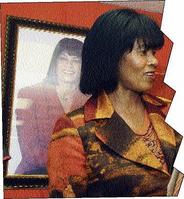
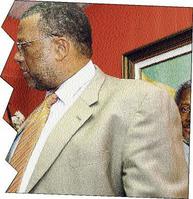
Simpson Miller and Phillips
Even the normally astute and spot-on political commentator Paul Ashley seems convinced, with his usual stridency, that the Peter challenge is a misguided one at this time, and that it can only benefit the JLP. It's suicide, says Lambert Brown, no neophyte to politics and a well-known Portia supporter.
Peter Phillips uses the same set of facts, but interpret them differently. Peter also reads the polls and senses the grumbling on the ground that the economic burdens are increasing on the people and that they more are likely to blame the JLP for its inability to help them. He knows that people are not taken by rational explanations of their economic misery. They make decisions based on their gut feelings rather than on intellectual contemplation. With the global crisis not easing, the failure to attract jobs, jobs, jobs and with crime scaring the hell out of everybody, with no end in sight, and no funds to adequately support social intervention programmes, the people will start looking to the PNP, Peter reasons.
But Peter knows that though many might be disillusioned with Bruce, they have the haunting belief that Portia could do no better and is not up to the job. Peter knows that the "capacity" issue, raised in the presidential run-off in 2006, is still a major issue, despite its political incorrectness. People's doubts would have been reinforced with Portia's actual performance in office, he deduces, and Peter would surmise that it would take no effort for the brilliant JLP public relations machinery to crank up a credible and deadly campaign to remind people of her alleged failures in office.
The Vaz ruling by the chief justice and the one that is upcoming are major factors in the equation. No government under this kind of battering from international forces and local criminal gangs would be thinking about calling elections, but some think Golding might have no choice. Peter wants to know that when the call is made, his party has a good chance of answering that call successfully, and he seems convinced that Portia would be a liability as leader, and that many in the country perceive him as the person best able to confront Bruce Orrett Golding intellectually. He has the solid middle-class credentials, the Drumblair connection, the right inflection, the right school tie, university network, acceptability by the upper classes and even - yes, it's politically incorrect - the right skin colour.
Two electoral defeats
Peter would probably reason that the P.J. Patterson view that Portia was (is) the only hope for the PNP has already been exploded twice in 2007 when she led the party into two electoral defeats. Therefore, her invincibility has been shattered. Her tumbling in the polls, though she is still substantially ahead of him, again, in Peter's mind, indicates that her grass-roots power has also been broken.
As Peter sees it, Portia is vulnerable; Bruce is vulnerable and this is the best time to make his move. It could not have been an easy decision for him, for he knows the cultic atmosphere in the Jamaican party political culture. Though the PNP boasts about its "respect for the democratic traditions" and the fact that any member can vie for any post in the party and challenge anyone, the Portia faction expresses consternation at Peter's temerity in breaking the 70-year tradition of not challenging a sitting party president. So Comrades stoutly affirm the sacrosanct democratic tradition and the fact that no one has dared to challenge a sitting party president without noting any sense of irony. Well, Peter Phillips has broken the mould. And as in all cultic types of environment, he has earned the title of being disloyal, a traitor, working for the other side, a fool and a power-glutton.
Comrades always refer to the authoritarian and personalistic leadership tradition in the JLP, but their response to the Peter challenge betrays no different spirit. Comrades should be proud that in their party someone can challenge a sitting president - and a popular one at that - without any recrimination, if they truly honour democratic traditions.
If ever we needed evidence that our party political culture needs reforming and that our political parties need to stop operating as private clubs, the reaction of outrage to Peter Phillips' democratic and constitutional challenge to Portia Simpson Miller should provide it.
There is another crucial matter - money. Peter Phillips knows that 'big money' will not be backing the PNP while Portia is leading it. The PNP would be starved of funding and you can't win any political election without money. No matter how popular and loved you are, you had better have money to keep it so! This is a crucial point. It was 'big money' which played a major part in getting out Edward Seaga. When 'big money interests' decided that Bruce Golding was more favoured, then all of those inside the party who wanted to get rid of Seaga, but couldn't, had the ammunition to do so. We must never underestimate the power of capital in liberal democracies.
Funding
The kind of funding which Peter will get for his presidential run-off with Portia and in any national election will far exceed what Portia could ever dream of. This is an incontestable fact - and not even the Portia faction would contest this.
With sufficient money, Peter's 12 per cent rating as the leader best able to lead Jamaica as compared to Portia's 27 could change in a short time. Not only will he have more money to spend on the ground and to lavish on organisation, but he will have enough money to produce and place catchy, gripping ads and to employ the best spin doctors to manipulate public opinion and redefine the issues. Mark my word. Money and media - these are two pivotal factors and Peter will have maximum of both. For one, Peter tends to be more accessible to media and no one has ever accused him of not being able to get his points across effectively.
Portia's strengths, however, must not be underestimated. Her charisma and charm are still important and unspent factors, though they might not be decisive. She still has potent backers in the party and unlike 2006 some key MPs are by her side. Peter's main task will be to convince Comrades that as much as "we all love and adore Portia, the people will not choose her over Bruce", and the money needed to demobilise the well-oiled JLP machinery will simply not come with Portia at the controls.
Suicidal
So Peter can't carry out any campaign against Portia personally. That's suicidal. He has to subtly and creatively craft his message in a way which says to comrades, "Bwoy me luv Portia too; she great, but the big people dem will gang up on her and mek Bruce tek the election again." If the Peter faction tries to humiliate and denigrate Portia, they will risk an angry and venomous backlash, fracture the party and its chances of being perceived by the electorate as able to govern after their internal civil war.
It's a delicate balance. Many of us (including me) love Portia deeply. Peter does not generate that kind of emotional attachment. Some even see him as cold, detached. The Peter faction must also consider that faced with a most powerful JLP campaign, plus 18 years of incumbency working against her party and delivering the kind of performance which the PNP did under her leadership in the September election is a tremendous tribute to her. Even Labourites say that Peter could not have done as well against them. What makes him think he can do it next time?
Some could also point to the fact that it is a Portia-led PNP which is now in a dead-heat with the JLP. So she has proven empirically that she's winnable. Peter is an unproven factor. Just another intellectual Drumblairite who thinks he has the answers to Jamaica's problems, some might say.
One political scientist, writing in the book edited by Carl Stone and Aggrey Brown in 1976 titled Essays on Power and Change in Jamaica, said this of the failure of our educated elites: "For the future, the capacity of the elites to engender change would seem to hinge on their capacity to allow participation of groups who traditionally have been denied these opportunities, but whose capacity for innovation is enhanced by the fact - less than their more schooled counterparts - that they have not been enshrouded in the largely Anglophile school system and with the cultural inhibitions which such education brings."
That political scientist was Dr Peter Phillips.
Ian Boyne is a veteran journalist who may be reached at ianboyne1@yahoo.com. Feedback may also be sent to columns@gleanerjm.com.


















