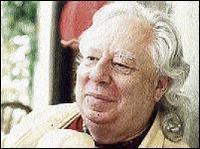
Books by Lucie-Smith (right) may have inspired many in the world of art. - Contributed
Dr Jonathan Greenland concludes his interview with art historian Edward Lucie-Smith about his life and work.
Should Jamaican art have a nationalist agenda?
Only in the sense that it should recognise and proclaim the fact that Jamaican culture is a survival story. It's about people who lost everything, and emerged at the other end of the ordeal able to make viable paintings and sculptures - and poems and stories and music. It's about the resilience of the human spirit.
People often say that the art of some other countries, such as Cuba, for example, has established itself on the international stage far better than Jamaican art. This is considered surprising given that Jamaica has been so successful in establishing itself on the world cultural stage with its music and general culture. Should this concern Jamaican artists? What can Jamaican visual artists do to make their work better known outside Jamaica?
Tough one, this. Basically, what Cuba had was Wifredo Lam, who, in turn, was connected to Paris and the circle round Picasso. Jamaica has never had an artist with that degree of international prominence. Bob Marley is, so to speak, the Jamaican equivalent of Lam.
Where do you see the role of new media in Jamaican art?
Inevitably, artists in Jamaica are going to get more and more involved with high tech - computers, digital imaging, etc - as that's the way the whole world is going. But Jamaica is not yet a high-tech country, and you can't force it. Basically, this development, if it is to happen, depends on the general level of education in the country as a whole, plus the availability of technology itself. And that, in turn, depends on economics.
You are probably most famous in Jamaica for your book 'Albert Huie: Father of Jamaican Painting'. What brought you to this project and what did you learn from it?
Working with Albert, and with his wife Miss Phyllis, was really a delight, not least because it was a way of getting back to my own roots in Jamaica which, as I think you know, go back to about 1800 - I can count at least five generations of ancestors in the island, and many more in the Caribbean region.
I think my father's family arrived in the early 1600s, then spent a long time in Barbados. In other words, my father's family were in the West Indies before Jamaica was taken from the Spanish by Penn and Venables. On that side, I have English, Scottish, Flemish, Jewish and (I am quite sure) black ancestors. My great-grandfather on my mother's side - she was English - was a leading abolitionist and a close friend of William Wilberforce.
I was brought into the project by JudyAnn Macmillan, Huie's pupil and friend. I loved - love - Huie as a person. And he loves the whole process of seeing something, then making a picture of it. He's made a terrific journey to become what he now is. While I recognise the charm of the Jamaican so-called 'Intuitives', by whom Huie was somewhat eclipsed at one time, the problem with naive art is that it can't develop. The moment it ceases to be naïve, it loses its emotional authenticity.
That is very interesting. to what extent does intuitive art need to have emotional authenticity, as opposed to other works of contemporary art? I ask because I think of an artist like Jean-Michel Basquiat who - and I know this is debatable - incorporated naïve qualities into a sophisticated contemporary style.
Let's start off by saying that it's wishful thinking to try to classify Basquiat as a naïve artist, of the same sort as Jamaican 'intuitives' or the similar artists you find in Haiti. He was certainly untrained - like Francis Bacon - but not naïve in the sense in which that adjective is usually employed by art critics and art historians.
Though he started as a street graffiti artist, he rapidly integrated himself with the New York art world, which is the most sophisticated community of its kind on earth. He was savvy, he knew what was going on, and he had a wide range of cultural reference. He even collaborated with Andy Warhol.
The limitations of naïve art are shown up by the contrast between artistic development in Cuba and Haiti. Ever since the emergence of Wifredo Lam, Cuban art has been fully integrated with Latin American art and through that, has connected itself with the world community of modernist and contemporary art.
Despite Cuba's economic isolation, due to the American blockade, the country has, throughout the Castro epoch, continued to produce inventive artists. These are accepted as important experimental creators throughout the international art world. Current examples are Tania Brugera and José Bedia, though both live mostly out of Cuba - Brugera in Chicago, Bedia in Miami.
An important factor in spreading the reputation of contemporary Cuban art has been the Havana Biennial, which has brought Cuban artists into contact with a wide range of artists of other nationalities.
The situation is totally different in Haiti. Characteristic Haitian art products today are naïve paintings whose naïvieté seems increasingly formulaic, not to say calculated, for commercial gain. There is no Haitian artist who attracts world attention. Basquiat, who was half-Haitian by birth, never lived there.
When Lam, accompanied by André Breton, the founding father of the international surrealist movement, visited Haiti to study voodoo rituals, he seems to have met no local artists.
In fact, Selden Rodman, the American modernist poet who was co-director, with another American, of the Centre d'Art in Port-au-Prince, and one of the chief promoters of Haitian naïve painting in the 1940s and 1950s, actively discouraged his protegés from taking an interest in, or making contact with, American and European Modernism.
Naïve art, paradoxically, is mostly valued by people who are not naïve who find in it an innocence which they themselves now lack. There seems to be no such thing as a naïve audience. This audience doesn't want naïve artists to learn, to develop their skills and their range of knowledge, and perhaps in the process to become something else. It wants to fence them in.
You regularly visit Jamaica and other countries that exhibit self-taught artists, do you have any ideas for how Jamaican Intuitive art could develop in the next twenty years? Are there areas that could still be explored?
I'm sorry. You are asking me about how to fulfil a wish that can't be fulfilled. As I said earlier, the whole point about naïve art - a.k.a 'intuitive art' - is that it doesn't develop. If you don't harvest it there and then, it just rots on the tree.
The flourishing school of naïve artists that existed in the former Yugoslavia under General Tito, and which was much publicised when Tito broke with Russia, is now more or less forgotten. The Douanier Rousseau is remembered, but has had no successors in France of anything like the same stature.
Haitian art, which is the closest thing to Jamaican intuitive art, has become horribly repetitive and horribly commercialised. You can get all the bad news you want by going to the Internet websites that market it.
The people to whom it is marketed, incidentally, are certainly not Haitians. It's what I call 'transactional art' - made in one society to be sold in another.
Quite frankly, Australian Aboriginal art is the same thing - it's not made for aboriginals. And this inevitably introduces a note of falsity. Do you really want Jamaican art to go down that road?
You have also written a book about the Jamaican painter JudyAnn MacMillan titled 'My Jamaica'. I imagine that was an enjoyable project?
Great fun. JudyAnn said to me, "If I get a book for myself, will you write it?" And I said, "OK, of course." thinking 'This won't happen,' as I know how incredibly difficult it is to get a publisher to do an artist's monograph - monographs are regarded as box-office poison.
Then she pulled it off, and called in the promise. The book has a really nice specification - Macmillan Caribbean (no relation) did a great job. And I think the book really speaks for Jamaica. Which, in turn, is why it has been a commercial success.
I first encountered you in the context of an exhibition of the artist Judy Chicago in New York and I had the strong sense of a bond between the two of you. Is this accurate?
Yes, there is a bond. I wrote Judy Chicago's career monograph, and we are still on close terms. The reason I wanted to write it is that Judy seems to me one of the few contemporary American artists who was trying to deal directly with important social issues.
I remember, when I'd at last got the contract for the Judy Chicago book - a process that took me five years - I suddenly got cold feet and said to Judy, "What's the sisterhood going to say when they find out that your book is being written by a white, male, European critic?"
She looked me up and down and said, "Well, they had their chance."
In your autobiography, you mention the importance of female mentors to you. Is there a reason for this?
Perhaps that springs from having Jamaican origins. Jamaica is still, fundamentally, a matriarchal society.
Also, I might rather ungratefully say that one reason was having to fight off a difficult mother, who wanted an obedient husband not an independent son.
I learned a lot, the hard way, about female psychology. But that didn't put me off working with women. In some ways it taught me how to work with them. And I've always been an egalitarian: I think women still get a rough deal, and the able ones aren't always valued as they should be. I can listen to women, as I think many men can't.
If not a poet, photographer and art historian, who or what would you have liked to have been?
There is no answer to this. If I was not the person I am, with the interests I have, I would, logically, be an entirely different personality. And who knows what that person would like?
By the way, why exactly did you title your autobiography 'The Burnt Child'?
The full quote is "The burnt child fears the fire." I suppose I meant to allude both to a childhood in Jamaica [I sunburn very easily] and to the fact that one learns to be wary of certain things from direct experience of them.


















