
BE WELL - Eulalee Thompson
Toxic substances dangled menacingly in the thick, ugly smoke that sat over most of the Kingston Metropolitan Area last week.
Volatile organic compounds, particulate matter, hydrocarbons, carbon dioxide, carbon monoxide, dioxins, hexachlorobenzene and nitrogen oxide were some of the toxic substances identified by Dr Vincent Wright, chair of Northern Caribbean University's department of biology, chemistry and allied health services.
The thick, ugly smoke was the result of spontaneous burning of solid waste material at the large city dump in Riverton City, Kingston. Spontaneous burning occurs in landfills when the waste is not properly compacted, leading to the production of methane gas, the same combustible gas used for cooking. Wright said that maybe a way could be found to collect the methane gas but he indicated that in properly compacted landfills, very little methane gas is produced. He illustrated this point when he cited the case of a newspaper, found after 40 years in a properly-compacted United States landfill, which was still legible because there had been no breakdown in substances.
Burning toxic substances
"In burning material on the dump site, these are the things expected to be emitted," said Wright, in reference to the numerous toxic substances to which the city has been exposed. "Because it is not a controlled area, there are pesticide containers, automotive oils, solvents, batteries and even asbestos. I went there (to the Riverton City landfill) earlier this year and I saw three or four containers of asbestos material to be buried.
Asbestos dust
Though the asbestos had been placed in sealed containers, it is well known that just one particle of asbestos dust is a great danger to health. Other types of potentially dangerous material are thrown on the dump site, such as old radios, television sets and electrical material.
Particulate matter released in burning waste is responsible for respiratory problems, including asthma; hydrocarbons are released in the atmosphere when leaves and trash are burned in backyards or at the landfill; burning old tyresproduces carbon dioxide and carbon monoxide, and in some situations, carbon monoxide can lead to neurological problems. Dioxins, Wright said, contain about 30 chlorinated chemicals, normally produced by burning, and tend to settle on plants. Livestock consumes the plants, then human beings consume the livestock, ingesting small amounts of dioxins which, over time, through bioaccumulation, can lead to cancer.
The expert said that because of the number of toxic substances in the smoke, the merest exposure to it will cause throat irritation, coughing, runny noses, sinusitis, shortness of breath, headaches, among other symptoms associated with distress of the upper respiratory system.
Damages the ozone layer
Some of the toxic substances, such as carbon dioxide and nitrogen oxide, released in burning will affect the ozone layer, setting up a cycle where there's variation in atmospheric temperature and precipitation that cause climate change which, in turn, will affect human health.
"So the burning may not affect health directly but, if we have climate change, over a period of time, we will be affected as we are more prone to diseases such as malaria and to more organisms," Wright said.
There are other environmental concerns regarding the location of the city dump on a high water table. This location will always impair the proper compacting of the waste, leading to the constant production of methane gas and, therefore, very frequent spontaneous fires. Equally frightening about the location of the city dump is that chemicals from the dump will leach out below and into the water table.
The long and short of it is that the dump is in the wrong place. Let's move it or let's decide to keep fighting fires in perpetuity and to keep sending up people's health care bills.
eulalee.thompson@gleanerjm.com
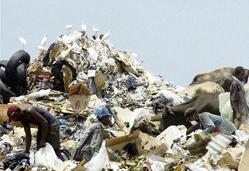
Human beings and animals rummage through the Riverton City landfill in Kingston. - Norman Grindley/Deputy Chief Photographer