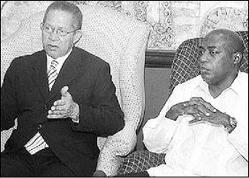
Prime Minister Bruce Golding (left) speaks about the fifth Extraordinary PetroCaribe Summit of Heads of Government, on his arrival at the Norman Manley International Airport, Monday. The summit was held in Maracaibo, Venezuela, on Sunday. With the PM is energy minister, Clive Mullings.
Caribbean countries can now retain up to 60 per cent of their oil bill with Venezuela as a long-term loan, up from the 50 per cent that the original agreement stipulated three years ago.
But oil must stay above US$100 per barrel for the new terms to hold. Under the arrangement, oil importing nations will pay 40 per cent of the price of shipments within 90 days, and the rest in 25 years at one per cent interest.
Prime Minister Bruce Golding said in Parliament Tuesday that Jamaica currently pays just about US$100 per barrel for PetroCaribe oil, which could qualify the country for the 60 per cent retention.
Oil prices
Venezuelan president, Hugo Chávez, also said Sunday at the fifth PetroCaribe Summit in Maracaibo that if oil reached US$150 per barrel, countries could retain 70 per cent under the same repayment terms, including partial payment commodities, such as rice, bananas and sugar.
"That could compensate for the horrible curve of the jump in oil prices," Chavez said.
Oil, in the past two weeks, has topped US$147 per barrel, with forecasts of US$200 by year-end.
The three-year-old PetroCaribe facility offers a quota of up to 125,000 barrels of oil per day — Jamaica's is 23,000 barrels per day — to members to the accord, but data released on the weekend shows the initiative is not operating at full strength because of transportation and storage problems.
But Wednesday Business under-stands that Jamaica, which operates a 36,000-barrel-per-day refinery, is not among the countries whose supplies have been falling short.
Improved distribution
Oil minister, Rafael Ramirez, said member countries other than Cuba are receiving a total of 86,000 barrels of oil a day - significantly less than their quota of 125,000.
Ramirez said Venezuela expects performance will improve with the expansion of an oil distribution network in the Caribbean, including installing storage tanks and rehabilitating Cuba's Soviet-era Cienfuegos refinery.
St Vincent and the Grenadines expects to complete construction of a storage facility next year with Venezuelan help, allowing it to boost the 300 barrels a day it currently receives - less than a third of its PetroCaribe quota, said Thornley Orsino Myers, who heads a St Vincent electrical utility and accompanied his country's delegation.
Agricultural aid
The pact, which has a development component, has helped Chávez promote his vision of regional independence from the United States.
The Venezuelan president further announced at the summit that he plans to broaden the accord to make it into an "anti-hunger shield" for countries in the Caribbean and Central and South America.
To help boost agriculture, Chávez said Venezuela will donate US$460 million from its oil proceeds annually to create an aid fund for farming supplies and machinery in the region.
He also offered to supply subsidised fertiliser to other countries.
Leaders at the meeting in the western city of Maracaibo included President Alvaro Colom of Guatemala, which was welcomed as Petrocaribe's 18th member.
Venezuela said delegations from 15 countries attended, including 11 heads of state.
Gleaner and AP reports