Mark Dawes, Religion Editor 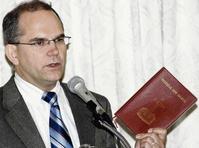
Kirk Franklin of Wycliffe Bible Translators, as he speaks to a group of pastors in Kingston earlier this year. - Ian Allen/Staff Photographer
Despite the progress made in translating the Bible to many languages, there are still 300 million persons in the world, who do not yet have a verse of scripture in their indigenous language. Here is where the Jamaican and Caribbean church can make a difference.
That was the view expressed by Kirk Franklin, president of Wycliffe Bible Translators International, during a visit to the island earlier this year.
Franklin, 49, became president of the organisation on January 1, and, almost immediately, he began a familiarity tour of some of the 48 countries represented in Wycliffe International.
Wycliffe Bible Translators is named after John Wycliffe, who, in 1380, first translated the Bible into English. John Wycliffe's translation preceded the Protestant Reformation and the translation of the King James Version in 1611. In fact, the King James Version owes much of its phraseology to the Wycliffe translation.
Translation challenge
Today, about 95 per cent of the world has access to the scriptures in whole or substantial parts. Five per cent, or 300 million, do not have as much as a verse in their own tongue.
The world, according to Wycliffe International and the United Bible Societies, has about 6,700 languages of which 700 are in decline. The Bible, to date, has been translated into 3,000 of those languages.
The challenge for Wycliffe, the United Bible Society and other Bible translation organisations, is to translate the scriptures into the remaining 3,000 languages in order to reach that five per cent.
For the last 60 years, the Bible has been translated into a new language at a rate of one for every three weeks. This means it would take about 150 years to translate the Bible for people who don't already have it.
In 1999, Bible translators from all around the world met and resolved that 150 years was too long to wait for everyone to have a copy of the Bible in their own language.
Not on target
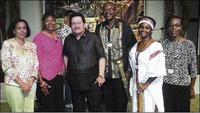
Earlier this year, Wycliffe Bible Translators convened a dedication service to commemorate the recent completion of the New Testament for the Kagayanen people of the Philippines. The dedication service took place in April in both Kagayancilio Island and Palawan, in the Philippines. Among those present for the dedication was (from left) Catherine Wharton of Wycliffe Trinidad and Tobago; Jackie Huggins, Wycliffe's chief translator for the project, who hails from Trinidad and Tobago; Edward Hagedorn, mayor of Puerto Princesa, in Palawan; John Roomes, chief executive officer, Wycliffe Caribbean; Jo-Ann Richards, Wycliffe representative from Jamaica, and Denise Smart, Wycliffe representative from Trinidad and Tobago.
- Contributed
As a result, Vision 2025 was born - a plan to step-up Bible translation so that everyone may have access to the Bible in their own tongue by 2025. This means translation into a new language needs to take place at the rate of one every three days for the next 23 years.
Franklin concedes that Bible translation work is not on target for 2025. He said, at the current rate, it seems the Bible will be in the hands of every tongue and nation by 2038.
He said: "In the last eight years, there has been a concerted effort and we have seen about 600 to 700 languages in which the scriptures have been translated. The challenge is that much of the remaining languages are in very difficult countries, either because of civil wars, closed access, or various religious issues, that might prevent work. That is a huge issue for us. While we have made significant progress with this vision, there is always other realities that serve as barriers that only God can address those barriers".
Bible translation work in some countries can be life-threatening, and some of Wycliffe's people serving in hostile environments have been killed - though not in recent times.
"We do all we can to protect our people. We can't be reckless in our witness. We have to show responsibility. Some years ago, we shut down part of our work in a South American country because it was too dangerous for our missionaries there. Other times, it has been temporary evacuations, particularly in Africa with civil wars," the Wycliffe president said.
Early background
Franklin was born and raised in Papua New Guinea. His parents were missionaries there. Papua New Guinea has 860 languages of which 400 are without a version of the Bible. Franklin speaks East Kewa and West Kewa and a creole language.
He is both a citizen of Australia and the United States. He is married to an Australian and they have three children. His office is in Australia.
His tertiary education was in the United States where he studied at Moody Bible Institute and Dallas Baptist University. He is a specialist in visual communications and has taught related courses to various Christian groups to show how it could be used to promote evangelism.
Wycliffe Bible Translators, he explained, "exists so that the people of the earth, the people of all nations, who don't yet have scriptures in their mother tongues, at least have the opportunity to do so if that's what in their best interest. If their heart language, their vernacular, their mother tongue, is the best language of communication for them, then for the church to reach these people, nurture them, disciple them.
"There is enough evidence that you need to have the Bible, the scriptures available in that heart language. So, Wycliffe from its inception in 1935, was trying to meet the needs of these indigenous people groups that are all around the world."
Global leadership
As president of this global organisation, Franklin has two priorities.
First, "my priority is to quickly establish a global leadership team which we never had before. We have been basically a Western organisation, trying to not be Western. But so much of our core was still based in the United States for obvious reasons - that was where we were formed. In the appointment process, they said whoever was going to hold the job would not be living in the US.This would help to intentionally position Wycliffe to be an international organisation".
New headquarters
"Soon, Wycliffe International will be announcing that our operational headquarters will be in Singapore. We will really be working more a virtual concept. We don't aim to have a big infrastructure. We have 12 leaders around the world in strategic locations. The majority of those people will eventually be from non-western backgrounds.
"There needs to be a worldwide church involvement in the work of Bible translation, not a western organisation only or Global South only. The strongest movements of the church are in the Global South and they will feel more comfortable working with an organisation that does not look like it is western or American, in terms of being highly structured and with big corporate offices. We are working hard at networking and really trying to get churches involved.
Financing priority
Second, he said the effective financing of the organisation will be a top priority.
"Missions cost a lot of money. Historically, it is western money. But God has blessed the nations of the earth. So often, the churches have just not been asked, or given an opportunity to participate, because someone else was doing it instead. We want to make it possible for people of all nations to participate, regardless of the income of those churches and those nations."
There are three geographical areas in the world that are strong on Wycliffe's radar for Bible translation work. These, Franklin said, are the three highest concentration of languages that don't yet have the scriptures.
"The first part goes from Indonesia in the west to the Pacific Islands including Papua New Guinea and Vanuatu. The second is in mainland Asia. It covers a lot of closed countries. These countries are not open to the traditional form of missionary work, but they are more open to research and linguistics and literacy. In mainland Asia, it is about 700 languages. The third is in central Africa, including Nigeria. This covers another 700 languages."
The Wycliffe chief argued that Jamaica, with its history of colonialism, diverse ethnic make-up and long Christian heritage, was uniquely poised to send missionaries to do Bible translation work in some of the difficult countries of the world.
He said: "The effects of colonialism are still very apparent in the world and it still affects missions' work because missionaries were historically sent with colonial powers. So, the two get confused a bit. Even up till now, Christianity has been identified as a western faith. But, demographically, that is not true. The majority of Christians do not live in the western context. So, when you get into the issues of skin colour, particularly in countries of darker skin, which would be Africa plus parts of Asia, there is no question that persons of Jamaican ethnicity would fit in much better. They are warmly received because they look similar and they blend in. They (the Jamaicans) are different but they are seen as even representing the colonial powers. They are non-threatening and more relational. These are significant issues in mission work.
Take up the challenge
"My encouragement to the Jamaican church is to take this seriously. This is your DNA. This is also your opportunity. We are not looking at the world of missions, saying some nationalities are more valued than others. It is all nations. God raises up a global church of all nations. What we would say to the Caribbean is, this is your time to join in with what God is already doing.
"You have had a couple hundred years of missionaries coming here. God is probably saying, 'You have been a recipient, now you get to be a sending country' . It is an incredible opportunity for Jamaica.
"I think the African Christian and new believers need the encouragement of Jamaicans about what God is doing here. You have had the gospel much longer, in some cases. Just that response, that love, that fellowship will go a long way."
Send feedback to mark.dawes@gleanerjm.com.


















