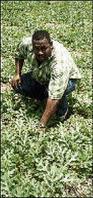
While others focused on the many challenges of the agricultural sector such as the spiralling cost of fertiliser, increased wage bill, chemicals and praedial larceny, 35-year-old Peter Campbell was not perturbed.
Instead he stayed on course to become a successful farmer and, according to him, "business has been doing well over the years".
Campbell, a native of Flagaman, St Elizabeth, has been involved in agriculture for the past eight years and employs approximately 15 people to man his 25-acre farm of tomatoes, melons, cantaloupes and honey dews.
This enterprising farmer has always been business-driven, as he points out that with no training in agriculture, he decided to learn from another farmer in the community.
He explained that while gaining on-the-job experience, and remaining steadfast to his goal, he would save the income he earned, which he later used as capital to finance his venture.
From scratch
"I started from scratch and from there I expanded and eventually stopped working for the gentleman and went on my own," he revealed, while adding that the prospects for his farm were favourable.
He indicated that while other persons his age partied and wasted time, he focused solely on his business, weekly reaping yields of approximately 7,000 lb of tomatoes, 4,000 lb of cantaloupe and 15,000 lb of melon, and honey dews, to supply hotels, vendors and supermarkets.
Although yields are bountiful, Campbell complained that there are instances when spoilage occurs, which, he says, is further exacerbated by gluts in the market.
Avenues available for farmers to dispose of excess produce are sometimes inadequate, and he maintained that the Government could establish another factory, similar to the one already in the parish, to puree fruits in abundance.
"The factory in Bull Savannah can only take 20,000 pounds of melon per week and that is a small amount when compared to the farming community.
He is plagued by theft of crops and similar to others in the parish, has employed creative ways of dealing with it, even though it is a temporary fix.
"What I would do each night is arrange with some of my employees to watch the field before the crops reach maturity," said Campbell.
The Government implemented a receipt book system to help farmers such as Campbell deal with the problem of praedial larceny. However, according to the businessman, the move has not been effective.
According to Campbell, the system breaks down because farmers can't write receipts for their own produce. This eventually causes a problem when transporting goods to his clients as he is stopped and at times has problems with the police.
"We find that it pressures the farmers, not the thieves," he insisted.
St Elizabeth, is one of the parishes plagued with inadequate water supply and, as Peter explains, he, similar to many other farmers in his community, has had to make the sacrifice of purchasing water from rapid response trucks.
However, with the doubling of the price of water, the farmer has been forced to literally move to another location in the parish where the commodity for irrigation is readily available.
"What I have done is move my farm to the Little Park area during drought conditions where irrigation facilities are available and water is cheaper. I will move back to the regular field during the rainy season," he explained.
Expansion
Being fully aware of the food crisis impacting the world and the financial gains of farming, plans are already afoot to diversify his offerings into other areas.
To that end, 20 acres of land has already been identified and is being readied for planting papaya, a commodity he hopes to market to hotels, restaurants, supermarkets and vendors.
When all is said and done, the 'St Bess' has reaffirmed his commitment to the agricultural sector, as it is his view that in everything there is a balance. "Sometimes you gain and sometimes you lose. It's really hard at times but I am not giving up," he said.
For his persistence, the farmer has a home and car to show as fruits of his labour and he believes that had it not been for the commitment to his dream, and sticking to the decision to become a farmer, even when faced with difficult circumstances, this might not have been possible.