Michael Reckord, Gleaner Writer
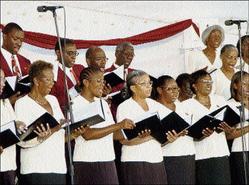
Members of the Diocesan Festival Choir perform during a gala presentation under the theme 'Feet of Jesus', held at Emancipation Park, New Kingston on Sunday, June 22. - Winston Sill / Freelance Photographer
Even without her music being played, composer Dr Judith Cloud would have enjoyed being in Emancipation Park early Sunday evening.
Nature did her best to make the period perfect. A gentle breeze cooled the area as the slowly setting sun lent a golden light. The sky was clear.
The people in the park showed their appreciation in a myriad of ways. Children cart-wheeled, lovers cuddled, friends chatted, joggers slowed to a stroll and security guards were friendly.
The focused activity in the park at the time, though, was a concert by the Diocesan Festival Choir, a concert which included Dr Cloud's music, which is why she might have been there. Unfortunately, she had business in Fidenza, Italy.
She sent an apology, reproduced in the concert's printed programme, which read in part: "To all the performers, my best wishes as they work on, then perform my music. I have such a good feeling about the purpose of the performance and I love the idea of the presentation at Emancipation Park."
Job well done
The music Dr Cloud referred to was the cantata Feet of Jesus, which she created using poems by Langston Hughes.
Dr Cloud's anticipatory "good feeling" would certainly have been magnified if she had been able to hear Sunday's presentation.
Under the imaginary baton of conductor Michael Sutherland, the 40-strong choir gave a performance which had the large audience applauding enthusiastically as the final notes died.
Later, individual audience members were overheard by The Gleaner congratulating members of the choir on a job well done.
Feet of Jesus, originally several short poems by Hughes, is, as a cantata, divided into seven movements.
A programme note stated that two poems, Litany and Sinner, were used as one movement.
The other poems were titled Feet of Jesus, Prayer, Shout, Fire, Angels' Wings, and Spirituals.
The tone of the poems harks back to a type of Christianity that is, I believe, fading away.
It views man as a helpless, suffering, degraded sinner in danger of being punished with fire and brimstone.
For example, one stanza of Fire reads:
Fire, fire Lord! Fire gonna burn ma soul!
I ain't been good, I ain't been clean
I been stinkin', low-down, mean
Fire, fire Lord! Fire gonna burn ma soul!
But the sincerity and belief in God's mercy comes through and, ultimately, the poem is hopeful: "Gonna ride in my chariot some day!" the author declares.
In her programme notes, Dr Could wrote of the experience of composing the work between the summer of 1989 and May 1991 when it was first performed, at Calvary Episcopal Church, New York.
Complex work
The promise of that premiere performance, she said, "in a truly marvellous space with an excellent semi-professional choir and first class soloists" gave her the strength and inspiration to finish the work.
She states: "I taught all day and composed from 6:00 in the evening until 2:00 in the morning many nights. Much of the music I composed astounded me. I felt as if a higher power was guiding my hands at the piano. It was unlike anything I had ever experienced."
The result is a complex, multi-layered, poignant work and all the performers should be proud of themselves.
I refer to the choir, the soloists, Christine MacDonald-Nevers (soprano) and Kevan Williams (who sang the baritone role, substituting for David Reid, who was under doctor's orders to rest), guest saxophonist Ian Hird, keyboard accompanist Ann Trouth and the conductor.
Aesthetically pleasing though the park was, it was not acoustically ideal for a concert. The huge speakers distorted the sound, somewhat, and the ambient noise competed with the music.
I was pleased to see, therefore, that three performances were scheduled for the work. That means there are two to go, though the programme did not give details.
The cantata took up the second half of the concert programme. In the first half, the choir performed nine items, well known hymns, classical pieces, a couple of songs from Broadway musicals and a Yoruba folk song, Betelehemu. They also delighted.
Guest appearance
There was a special guest appearance by members of Praise Academy of Dance. During the intermission, they treated the audience to a short celebratory dance item.
Also during the intermission, The Gleaner learned from Ian Hird's brother, Albert Shaun Hird, the recently appointed bandmaster of the Jamaica Military Band, about plans he has for the band.
They include increasing its membership from 34 to 40-odd, working with the Jamaica Constabulary Force band and resuming, at the end of July, monthly performances at Hope Gardens.
Toward the end of the concert, the Rt Rev Robert Thompson, Suffragan Bishop of Kingston and Chairman of the Diocesan Festival Choir Management Committee, declared the concert "a gift to the city of Kingston."
The audience's response would have showed that the gift was gratefully received.


















