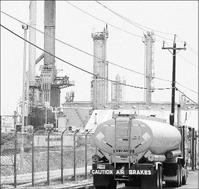
An oil tanker heads towards the Petrojam Refinery on Marcus Garvey Drive, Kingston. - File
The US$63 million which the Venezuelan national oil company, PDVSA, paid for a 49 per cent of Jamaica's Petrojam oil refinery was more than the Government was willing to accept for the entire facility in the mid-1990s attempted management buy-out of the plant, the contractor general's review of the deal has revealed.
At the same time, Contractor General Greg Christie, in his vindication of the price at which the former administration sold the stake, said the deal was based on the independent valuation of Petrojam by the Texas-based independent oil consulting firm Purvin and Gertz Inc (PGI), using the company's income stream.
In fact, PGI's US$128 million valuation was US$2 million higher than that provided by another firm, Muse Stancil - the difference apparently relating, in part, to the periods of the reviews.
"However, after protracted negotia-tions, the value (US$128 million), this value was accepted by both parties," Christie said in a report recently tabled in Parliament. "The corporations subsequently agreed on a sale price of US$130 million and 49-51 per cent share split with the PCJ (Petroleum Corporation of Jamaica) owning 51 per cent. Accordingly, PDVSA would pay US$63 million for 49 per cent shares in the facility."
PDVSA had initially, it appears, disputed the valuation of the 35,000 bpd refinery and had offered less for the stake.
Even at that, more than a decade later, Jamaica did far better than what was apparently on the table, and the Government was willing to accept in 1996.
"The Petrojam team also hastened to add that in 1996, the Government of Jamaica had wanted to sell the entire facility for less than the cost that the PDVSA was willing to pay for the 49 per cent stake in the facility, that is, US$63 million," Christie said in his report. "Conse-quently, they felt comfortable in accepting the value which was put forward by PGI and the negotiated sale price of US$130 million which was settled for the same. They were confident that they had achieved value for the money on behalf of the Jamaican taxpayers."
The contractor general did not specifically identify the 1996 deal. However, in the mid-1990s, a management group, led by the then Petrojam managing director, the late Pete Fenton, attempted to acquire the finery. The deal collapsed when the group failed to raise the cash.
Probed deal
Christie decided to probe the PDVSA deal in the face of a claim by Prime Minister Bruce Golding, while he was in Opposition, that the former People's National Party (PNP) government was selling the stake way below market value. He had claimed the real value of Petrojam, a subsidiary of the PCJ, was US$300 million - more than double the PGI valuation.
Golding did not substantiate the claim, but suggested that the infor-mation came from credible sources.
At the time, the PNP government was pushing ahead with a plan with the Venezuelans for Caracas to acquire a stake in the finery as part of President Hugo Chávez's PetroCaribe initiative to create energy partnerships with countries in the Caribbean and Latin America. The plan called for the expansion of the old and inefficient refinery to 50,000 bpd, as well as upgrading the facility to higher quality fuels.
Golding and the Jamaica Labour Party, however, was wary of the radical Chávez foreign policy in the Caribbean and criticised Jamaica's deepening involvement with Petro-Caribe, which allows the island to bet get long-term, low-cost credit on 40 per cent of the oil it purchases from Venezuela.
Courted Venezuelans
The Golding administration, in office since last September, has, despite the prime minister's previous stance, maintained PetroCaribe and has aggressively courted the Venezuelans. Ironically, the inflows for the Petrojam sale played an important part in narrowing the country's fiscal deficit at the end of the last financial year at March 31.
Christie's report suggested that Golding and his sources might have confused the projected cost of the first phases as of the planned upgrading of Petrojam with the value of the existing facility.
"... It must be noted that an estimated capital cost of US$300 million was presented as the cost of the upgrade of the refinery was to be undertaken by Petrojam, in partner-ship with PDVSA, and not as the value of Petrojam," Christie said.
"In the circumstance, the OCG (Office of the Contractor General) has concluded that there is no merit to the allegation which was made by the then leader of the opposition, Golding, that Petrojam's shares were sold below market value or that the correct value of shares was in the region of US$300 million," he said.
business@gleanerjm.com


















