Latoya Grindley, Features Writer
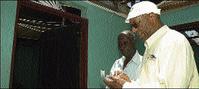
In this October 2007 file photo, Pastor Patrick Allen, president of West Indies Union Conference of Seventh-Day Adventists, takes note of the needs of 85-year-old pensioner, Thomas Collins, at his home, which was damaged by Hurricane Dean, in Dry Hill, Portland Cottage, Clarendon. Some residents of the community are fearful as the hurricane season approaches. - File
ON ENTERING THE Portland Cottage community, you are greeted by a sign which says, 'Do not enter when flooded', along with an erected measuring post, possibly to gauge water levels whenever heavy rains pelt the Clarendon community. This usually happens during the hurricane season, which lasts from June to November each year.
Most of the houses, which are nothing more than dilapidated structures, are abandoned. They stand without roofs - a horrific reminder of the battering they received from Hurricane Dean last year, and successive periods of heavy rainfall.
still recovering
Since the last hurricane in September 2007, some residents are still trying to recover from their losses. Shirley Maragh, who has been living there since birth, says she is always affected whenever there are heavy rains, much less a hurricane.
"We always get it bad man. You see all last year, the water reach me at my chest. I was so frightened. Right here did just look like a big sea and everything just tear down because of the water plus the wind."
Pointing to a piece of furniture outside her house, Maragh says she is still in the process of replacing furniture, having bought the necessary ones like beds and a refrigerator to kick-start her recovery. But having gone through these episodes repeatedly, the 50-year-old says she is not necessarily making any preparations for the upcoming hurricane season. "No matter how we prepare, we going to get it bad. I don't have anywhere else to go. So, when something happens, we just have to pick up the pieces," Maragh relates.
Not wanting to relive September 2007, when Hurricane Dean visited, she plans to stay with her daughter in St Elizabeth.
more traumatic every year
Her son, Jerry Maragh, says each year, the experience gets more traumatic. "I don't know how we manage man, it frightening. You see if I hear say a hurricane coming, a gone me gone. I don't think I can deal with another hurricane or a lot of heavy rain right here suh," Jerry says.
Explaining why there are so many abandoned houses in the community, residents inform us that several families moved to a housing scheme nearby, following Hurricane Ivan in 2006.
That particular scheme was built to relocate those affected by Ivan. Vinnette Thompson, who lives there, says she is grateful for her house, but is dissatisfied with what she calls poor construction.
not safe
"Up here we don't have a flooding problem, but the zinc roof not strong. Look how many top gone. Even those houses with slab roof not safe. My sister live in one, and during Dean, she say the house top lift off and slam right back down," says Thompson. Another resident of the relatively new scheme, Marie Levy, says her experience during Hurricane Dean was nerve-wracking. "I was in my house and the house a shake like mad and me hear like roof lifting off. We glad for the help, but do something for the community, man! We don't even have street light in here and not even piped water," she says.
Both women say they are not making any preparations as the hurricane season approaches because "there is nothing we can do".
latoya.grindley@gleanerjm.com


















