Glenda Anderson, Staff Reporter
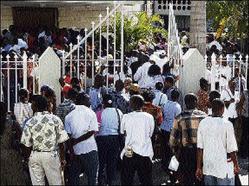
In this 2005 photo, hundreds of farm work applicants gather at the St Paul's United Church, in Montego Bay, St James, hoping to be selected for the programme. Jamaicans are among the thousands of migrants recruited by United States and Canadian companies to work on farms. - File
Today, we continue our report on displaced Jamaican farm workers in Florida. The Sunday Gleaner reported yesterday that more than 2,000 of them are seeking compensation from their former employer.
Since their displacement following the mechanisation of farms in the 1990s, local community-based groups in Florida, as well as several government agencies, have been offering assistance to the community of former Jamaican farm workers.
Recently, at a passport drive organised by local resident Vonnie McGowan-Arscott, several of the former sugar-cane workers had angry questions.
"We would like to find out why they just drop us like that. We still Jamaicans. It is they (who) seek out this programme, they promise to keep us, and now we on we own," another explained.
Jamaica's consul general in Miami, Ricardo Allicock, says his office has been meeting with the men at intervals.
He says the group has partnered with the Registrar General's Department in "providing current valid identification to those persons in Belle Glade who have expressed such a need."
Passports are processed through the office at a fee of US$110. But the consul general's office could not tell how many persons from the group had applied for or received passports or birth certificates on any of their trips in the last three years.
In jeopardy
Cecil Weir, deputy liaison officer for Jamaica's official recruiting agency in North America, Jamaica Central Labour Organisation, places some of the blame for their situation on the workers whom, he says, had many resources from which to get advice and legal help, but did not.
He says the men should leave.
"They are in jeopardy. Some might be faced with deportation. The only thing is for them to return home."
He says although some cling to hopes of compensation or welfare benefits in the US, they may not qualify.
"Agricultural workers under the programme (H2-A), did not contribute to social security, so unless they had changed their status, whether by applying under the SAW programme or worked with private employers who would have paid social security for them, then there is nothing really for them to get."
Lawsuits filed on behalf of different groups of workers were unsuccessful. But the workers argue that there is legal compensation yet to be paid.
Squalid conditions
Weir says in one case involving the company, US Sugar, workers who were a part of the lawsuit were paid.
"The payouts were handled by the US Department of Labour. There is a general misunderstanding about that as some workers who may not have been employed by US Sugar, anticipated a pay-out even though they had been with another company."
Today, some of the men live in squalid conditions - no electricity, running water or food. Some are ill or have work-related maladies, like recurring coughs, and a strained gait.
Some live in commune-like circumstances, sharing a bathroom, kitchen and rent at $50 a week for a small room. For those who work, cheques are written in the name of the landlord and cashed on their behalf, as they have no form of identification. Most cannot access medical care.
Checks with Kingston's social security ministry revealed that while qualified former farm workers could well be eligible for benefits under the National Insurance Scheme (NIS), this would be dependent on each worker's personal circumstances.
BENEFITS
Denzil Thorpe, who spoke on behalf of the ministry, says contributions are remitted to the NIS for farm workers by the US employers through the liaison service.
"We started receiving those in 1980. The basic flat rate contribution at the time was 30 cents per week, and it has increased gradually over time to the current amount of $20 per week.
To qualify for a pension benefit, a worker would need to have an average of 10 or more weekly contributions over the period to which they are entitled to contribute. For example, a contributor reaching age 65 this year would need a minimum of 420 weekly contributions to receive a pension.
Therefore, a Belle Glade worker who only contributed to the scheme through the Farm Work Programme would have had to be contributing fully for just over eight years to receive this benefit.
However, the situation would be different for those who made additional contributions as an employed person in Jamaica or through voluntary contributions.
Under the NIS, contributors who meet the qualifying conditions (or their dependents) can receive retirement, invalidity, widow/ widower, orphan or special children's benefits or a funeral grant.
In addition, all NIS pensioners are automatically enrolled in the NIS pensioner's health plan, commonly known as the NIGOLD.
However, farm workers would not qualify for employment-injury benefits, since they only make the basic flat-rate contributions," Thorpe says.
Mandatory process
Checks with the labour ministry's North Street office, confirmed that some money was, in fact, sent to Jamaica.
Courtney Prawl, director of the Overseas Workers Savings Programme, confirmed that while the process was mandatory, with each worker required to sign to give permission to have a portion of his pay sent to a welfare/savings account, some refused. For those who did, remuneration could still be there.
"All the paylists/cheques are processed and sent to the National Commercial Bank. Once it (money) is at the bank, it stays there."
Prawl says a worker's savings would still be available to him despite the length of time or whether he had abandoned his contract.


















