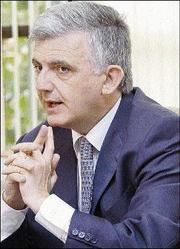
Marco Mazzocchi-Alemanni, ambassador to Jamaica for the European Union. - Rudolph Brown/Chief Photographer
HE COULD be called Mr Diversity. As head of delegation and ambassador to Jamaica for the European Union, Marco Mazzocchi-Alemanni knows how important it is to respect different cultures.
This representative of the 27-state union was raised in Rome, Italy, by a father who was a literary critic and housewife mother.
Mazzocchi-Alemanni has spent over 30 years with the EU in various positions, spending most of his time in Africa.
Married to an Algerian, his diplomatic interests lie in developing small and newly independent countries. It is one of the reasons he chose to come to Jamaica a little over one year ago.
This is an interesting time for the EU and the Caribbean. In late 2006, the organisation made significant changes to its sugar protocol, reducing the price it pays for sugar coming from African, Caribbean and Pacific (ACP) countries by 36 per cent over four years.
Locally, the organisation has pledged millions of dollars to help upgrade community centres and police stations across the island.
Mazzocchi-Alemanni divides his time between the countries for which he is ambassador: Belize, the Bahamas, Turks and Caicos and the Cayman Islands.

Tour of DUTY with SACHA WALTERS
What has Jamaica been like for you?
I spent 30 years of my life in Africa and I thought I would end my career in the Caribbean in a country that is very attractive for a number of reasons.
Most Jamaicans consider that their country is the centre of the world, which may not be entirely true or entirely wrong. It is true that when you travel around the world people know about Jamaica, even in distant villages in Africa. In Europe as well Jamaica is very popular but not just by Bob Marley; people usually have a restrictive view, Bob Marley certainly was a great performer and a very interesting personality, but the good personalities of Jamaica are certainly not confined to Bob Marley.
How did you begin working with the EU?
I started working with the European Union not because of Europe itself but because of developing countries. I've done my doctorate studies on economic and social development. When I finished studying I found that the one institution that was doing the most interesting work about developing countries, about newly independent countries was the European Union. Two thirds of grant funds that benefit Jamaica come from the European Union and its benefit states.
I have seen that the EU has been giving Jamaica a lot of support, particularly in agriculture. Any particular reason?
No, I don't think there is a particular interest in agriculture. Well, if you mean sugar and bananas, yes, that's very important.
When Jamaica and other Caribbean countries started their association with us in the mid '70s that's when we set up these protocols for sugar and bananas. Basically, these two protocols gave a special edge to Caribbean and other countries for exporting bananas and sugar into Europe. Now, because of the WTO (World Trade Organisation) we have had to phase them out. I'm very optimistic about sugar cane. I think that actually what the government is doing, privatising the sugar company is a very good move.
It's very welcome and basically in the intermediate term Jamaica is going to run short of sugar cane land because there is a big demand for sugar cane. Not just for sugar but for energy purposes. I think that the prospects are good for sugar cane. Bananas, I think there is a big market for Jamaican bananas but the big problem for Jamaican bananas and bananas in the Caribbean, are hurricanes.
Italians are big on their coffee, are you a big coffee drinker?
In the US I prefer drinking Starbucks than regular coffee. Of course we are very proud of our coffee and you're very proud of your coffee.
Is it comparative?
It's different. I very much regret that you don't grind Blue Mountain in such a way to make a good espresso. The way you grind it, it's good for perk. But if it's toasted and ground properly it can make an excellent espresso, and I will tell you I did have an excellent Blue Mountain espresso in Rome but very expensive.
It was like the equivalent of J$180 for one very small cup. But why was it good? It was toasted and ground in Italy in the Italian way. Most of your Blue Mountain coffee is shipped to Japan, I think that's very good because I'm sure you get a very good price for it, but I'm sure you can explore other markets.
In terms of our culture, do you have any particular love?
I've always loved reggae. It's music of my time, the '70s. I still like it but you have different variations. I listened to Bob Marley when I was in Africa and I loved it and I have a very vivid memory, he died when I was in Central Africa. The story that I always tell is that when I was in a French speaking country, all of a sudden (everybody in) that particular city was wearing a black armband in mourning for Bob Marley, and that was very telling.
I think you also have a very interesting scene in fine art. Here you have a lot of handicraft, but I think as always when there's mass tourism, handicrafts tend to become mass handicrafts and that's a real pity. It would be nice if people were more into quality handicraft. That's not to say that you don't have any quality because there is some beautiful pottery.
When in Rome
It is Italy's most populous city with just over 2.7 million citizens. Rome was the seat of fascism in the early 20th century. Benito Mussolini came to power there in 1922. The Food and Agricultural Organisation (FAO) is based there. The city will host the 2020 Olympic Games. Football is the city's most popular sport. There are three professional football clubs: A S Roma, Lazio and Cisco Roma. There are three airports in Rome.


















