Gareth Manning, Gleaner Writer
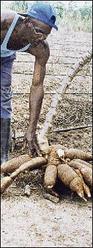
Mervin Thomas points to cassava reaped from his farm. Government recently announced plans to promote the increased cultivation of cassava in order to produce flour.
- File
At least one university professor is cautioning the Government against pursuing its plan to use cassava as an alternative to rice and wheat.
On Wednesday, agriculture minister Dr Christopher Tufton announced the move to use mined-out bauxite lands to plant the root crop for local consumption in response to the rising world prices of wheat and rice.
But Mark Harris, associate professor of environmental science at the Northern Caribbean University, Manchester, advises the Government to be guarded in introducing cassava as a main staple because it contains the toxic cyanide.
"In Nigeria, for example, cassava is widely eaten and is believed to be responsible for a nervous disease resulting in deafness and difficulty in walking," Harris argues.
FEW NUTRIENTS
He explains that while there are other cyanide-rich crops eaten by the Nigerians that do not have the same effect, the real problem with cassava is that it has very little protein - a third of the protein of wheat and rice - contrary to Tufton's pronouncements on Wednesday.
In light of this, Harris recommends that the Government complement cassava production with protein-rich crops.
"An adult consuming one kilogram of cassava has to ingest another 52 grams of protein from other sources to obtain the recommended daily allowance of protein per adult," he said. "Wheat, on the other hand, supplies 121 grams of protein per kg and rice, 61 grams of protein per kilogram."
Regular consumption of cyanogenic produce, such as cassava, he adds, also depletes the body's protein reserves.
Protein-deficiency diseases
"This leads to protein-deficiency diseases such as kwashiorkor - prevalent in some almost exclusively cassava-eating countries - and apparently, some nerve-based malfunctions," Harris states.
Dean of the faculty of agriculture at the College of Agriculture and Science Education, Captain Jonathan Lamey, is not as pessimistic about the consumption of cassava, though. He emphasises that while the crop can be poisonous, there are different varieties that are low in cyanide which the Government can pursue.
Types of cassava
There are two main varieties of cassava: bitter and sweet. The bitter cassava has 50 times more cyanide compared with the sweet variety. However, Lamey is convinced that less-toxic varieties can be developed.
"Since we live in a knowledge-based economy, let us manipulate the knowledge to produce non-toxic varieties of cassava," he says.
He agrees, however, that the Government must complement the large-scale production of cassava with protein-rich crops, such as beans, to provide a nutritious balance.
gareth.manning@gleanerjm.com
What is cyanide?
Cyanide is a poisonous organic compound formed through a fusion of carbon and nitrogen.
The cassava roots contain compounds, which produce cyanide.
Soaking or cooking the tuber can remove cyanide, but it is possible that enough may remain to cause disease over a period of time.


















