Paul H. Williams, Gleaner Writer

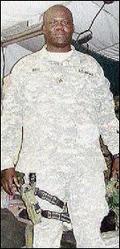
Corporal Steve Ellis of the United States Army poses in his tent while in camp during his tour of Iraq. - Contributed
Jamaicans all across the world watched the United States Army invade Iraq in March 2003 and took over Baghdad months later. Some viewed it as a war between Bush and Saddam. Many couldn't care less. It had nothing to do with us. That might have been the case. But, there were many Jamaican-born soldiers involved; many are still there, living in harm's way. Sergeant Steve Ellis, born at Collie Smith Drive, in Boys' Town, Kingston, is one such soldier.
From Fourth Street, Wilton Gardens (Rema), and Bull Bay, Steve Ellis, who served the Jamaica Constabulary Force from 1983 to 1995, migrated to the United States (US) in June of the year he ended his duty. He joined the US Army in 1996, and was trained as a tank crewman at Fort Knox, Kentucky, USA.
Uneventful life
His army life was uneventful for the most part until the US decided to find Saddam's 'weapons of mass destruction'.
"I had just come from Germany and got to Fort Stewart, Georgia, and two months later, I was on my way to Kuwait for regular six-month Gulf training. We were told we might invade Iraq and I never believed that for one minute," recalled the St Alban's Primary and Excelsior High schools graduate. He was then a tank gunner in a company called Cobras. "Well, I get a dose of reality when, in March, we were crossing the border and heading to Baghdad."
When his mom, who didn't want him to join the army in the first place, heard, she 'was really not happy about it', but with words of inspiration from his wife, he pressed on. For Sergeant Ellis himself, 'there was one piece of excitement'. But the road to Baghdad was long and hard.
First, his platoon sergeant's tank broke down. He was his wingman. The other members of the brigade radioed them and told them they wouldn't wait, and left them in the middle of the desert. It took them two hours to hook up the platoon sergeant's tank to his.
"You can imagine how lonely it was in the desert. When we started to move, we had no communication with anyone and did not know which way to go. So my tank commander said, "Let's see if we can find their tracks in the dark and just follow them." It took us three hours before we found them."
Journey into Baghdad
The entire journey to Baghdad was uncomfortable. He was cramped and miserable, riding in the gunner's seat, where he slept for two weeks. Sergeant Ellis recollected: "One night, we stopped for a break, and I told my tank commander I wanted to get out ... I told him I needed sleep, and I was going to find a spot on top of the tank to stretch out. I said I would rather die comfortable than miserable in the gunner's seat. He said I was on my own. I got out." This was after he was warned of the peril he was in.
Ten minutes into his sleep, there was rocket fire over the tank, so he rolled back into it. After the fire ceased, he returned to the top of the tank to sleep. When he awoke in the morning, the other three crew members were fast asleep, also on top of the tank. He laughed.
"Our first run into Baghdad was really interesting and exciting. It was called the Thunder Run. We just went up the highway to the Baghdad Airport, guns blazing, taking out every enemy and position we found. We lost one tank from my company on that run," he said, describing the entry into Baghdad.
They were excited when they reached Baghdad Airport, but it was a short-lived euphoria because he learned that one of his friends had died after being hit by a rocket. A few more soldiers from his company were injured, trying to recover the tank that was destroyed. He went through the entire first run unscathed, but at least twice, he came very close to serious injuries and perhaps death. But, it was not from 'the enemy'.
Stranded in enemy territory
It was during the second Thunder Run into Baghdad when Sergeant Ellis' platoon sergeant's tank again malfunctioned. Sergeant Ellis' tank and his first sergeant's vehicle remained to get the tank fixed. The rest of the battalion left, again.
"Well, on their return, they were shooting up bunkers making sure no one was in them. The other wingman (who was with Sergeant Ellis) was not looking and keptfiring his machine gun. I was standing in the turret of my tank along with my tank commander when we saw he was turning his weapon towards us.
"We both swore at the same time and dropped down into the tank as tracer rounds banged over our heads. My tank commander was just swearing, while I sat there not saying anything. I was scared as hell," wrote the man who represented Excelsior in the 400, 800 and 1500 metres, "We only came out when we heard shouting. My first sergeant was shouting and cussing the lieutenant on the tank. To this day, they never apologised."
During his second deployment, Operation Iraqi Freedom 3, he was sent to Sadr City where they made friends with the natives. For the one year they were there, they lost only one soldier and that was to sniper fire. And he was nearly taken out by friendly fire again. "They lit up my truck and said they could not recognise us in the dark. Good thing my truck was armoured, and they were firing M4s."
Third deployment to Iraq
Currently on his third deployment, Operation Iraqi Freedom V, Sergeant Ellis, who, at age 44, is described as the oldest person in the company, has much to be thankful for. Yet, this time around has been the worst in terms of fatalities and casualties. "My company alone has lost one, and five injured. And the battalion has lost so many soldiers to death and injuries. But it is the price of being a soldier, I guess," he said.
But outside of regular combat, what is it like to be a soldier in war-torn Iraq? Sergeant Ellis, who is Catholic, explained; "If you have no patrol for a day, most of the guys go to the gym, sit around playing video games, dominoes, cards and call home. Many attend church services also. We have a (cleric) for all denominations here, including Muslims.
"Every day here that we spend alive is a blessing. The constant walking or driving, never knowing when you are going to get hit by an IED (improvised explosive device) or EFP (explosive from projectile) is nerve-racking. One of my soldiers got hit by an IED and the question he asked when he was in shock was: "Why me?" He lost both legs and an arm."
And you would think that being in clear and present danger most of the time would be the hardest part of being in the US Army. However, for Sergeant Ellis, who is the father of a grown son, it is the "long deployment and being away from your family".
To cope with a hard day, he retreats to his tent to watch TV and play hand-held poker games, and sometimes American dominoes. Also keeping him on his feet are the words of encouragement he gets from old classmates, such as Hyacinth Josephs, Donna Myrie, Novelette Fellows, Coreen Francis, Michael Brooks, Michael Lyons and Marcia Livingston from Excelsior.
Now, a grandfather, he said, "I just had a grandson, and I have not held him yet. This is the motivation for getting back home safe and sound. And to be with my wife."
paul.williams@gleanerjm.com


















