Mark Titus, Enterprise Reporter
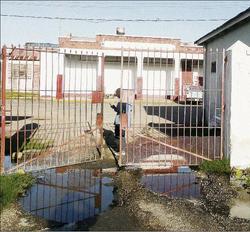
Water settles outside the Kingston and St Andrew Corporation abattoir in west Kingston. - Photo by Mark Titus
Jamaica's abattoirs and slaughterhouses paint an ugly picture of chaos, neglect, limited supervision and poor management, checks by The Gleaner have revealed.
The abattoir that serves the Corporate Area, located on Lindo Street, was buzzing with excitement when this reporter first visited the facility about three weeks ago.
Garbage and the remains of derelict buildings lined both sides of the muddy road leading to the location. Dogs walked freely on the compound, wagging their tails in anticipation as the early-morning sky was filled with the sounds of animals being slaughtered.
Animal remains lying around
Flies showed no interest in a chunk of offal lying on the corridor, alongside two motor trucks used to transport animals, taken in for slaughter.
The rundown cold storage at the entrance to the slaughter area was testimony to the kind of infrastructure that was in place in better times, while flies could be seen making the most of residue from the previous day's slaughter, on an aluminium cart.
A public health inspector (PHI) was among a group of about six men holding a conversation about West Indies cricket at the slaughter room.
"Lend me yuh stamp deh, Speck," a man said while walking briskly towards the PHI. This request was refused as the PHI looked suspiciously in my direction. Shortly after, a man came and told me that I could not remain on the compound. He told me if I was there to buy meat, I was too late. He then told me that my only chance was to catch up with Horace.
I soon learned that Horace supplies meat to the butchers and meat vendors at the markets in the Corporate Area. I immediately left for the Coronation Market, which, it was believed, would be his first stop.
The legendary market was a hive of activity when I arrived there. An elderly woman gave me directions to the meat area, reluctantly, when she realised I had no plans to purchase any of the breadfruit she had for sale.
Fishy business
I could hear the sound of chatter as I approached the entrance of the area where the fish vendors were housed. To my amazement, a vendor stood akimbo, holding conversation with another vendor who stooped, with her apron thrown over her shoulder, urinating in a drain that ran below a line of old refrigerators that were used to store fish for sale. A few metres away, in plain sight, vendors continued to sell meat. After relieving herself, the vendor wiped her hands in her apron, and then went back to selling her 'fresh fish'.
Horace had come and gone, most of the meat vendors were busy hanging out their purchase, while a small group gathered, discussing a new licensing rule. Drawing nearer to them, I learned that they were not pleased that they were now required to be the holder of both a butcher's and cutter's licence.
No proper certification
One man who claimed to be selling meat for more than two decades said that he had been operating without the required certification, as he had never been asked to produce one. I also learned from the conversation that PHIs would "pass through" once or twice per year, but only to take a look at the facility, not to conduct a thorough inspection.
Flies figured prominently in the area where the vendors operated, seemingly immune to the lime juice being used by a female vendor. The scene was the same at all the parochial markets that the team visited.
When I returned to the Kingston abattoir two days later, it was deserted. A man came running towards the vehicle as I parked. He introduced himself as Samuel, the watchman, and informed me that those who were in charge had left.
I told him that I wanted to establish a relationship with the abattoir, with the intention of them becoming the supplier for my meat shop. He told me that a Ms Davis was the person that I had to talk to, but she was gone for the day. He, however, agreed to give me a tour of the facility.
Dining area for dogs
Dogs were everywhere, making the most of the refuse that was thrown out. The chunk of offal that was on the corridor on my first visit was still there.
Opening the gate leading to the slaughter area, Samuel explained that the cold room had not been in operation for some time, so I would have to collect my meat as soon as the animal was slaughtered. He said a PHI was always there to "stamp the meat".
Asked if the relationship with the PHIs was such that they would stamp my meat without inspecting it, he said maybe, but warned me that it would "cost me a food".
Four pieces of meat, with flies all over them, were on a hook located in the passage leading to the slaughter room.
"Is hog liver," he said, when I asked what it was. "A man supposed to come collect it later."
The skin of a cow with its tail still attached was on the floor of a room next to the slaughter area, a watery substance running from it. "You can get beef for about $160 a pound wholesale," he says.
Intestines and other organs from slaughtered animals, along with bloodstained aprons, were everywhere. The aprons would be used the next morning during killing, my tour guide explained.
Equipment woes
Samuel showed me a machine which is used to remove the hairs of the animal. It showed years of neglect and was messy, bloody water running from beneath it. The greenish dirt on the wall made it difficult to tell what the original colour of the tiles was.
Two messy bathtubs were placed alongside each other, about four feet from the boiler, which, according to my tour guide, worked occasionally. According to Samuel, the butchers used the bathtubs to wash the meat with hot water after the killings. Convinced that conditions could not be worse in the other areas, I left.
Health hazards
The situation was the same throughout all the parishes, except for St James. All the slaughterhouses have been divested or closed by the respective local authorities. Those that are now in use are functioning below satisfactory requirements. Those visited by The Gleaner team are considered possible health hazards to the consuming public.
The St James abattoir in Montego Bay is caught in a stand-off between the parish council and the National Water Commission over the use of a wastewater plant.
When The Gleaner related some of the findings of our undercover exercise to Senator Norman Grant, chairman of the Jamaica Agricultural Society, he lamented that food safety standards were not being taken seriously.
"I think that as part of the repositioning of agriculture, the overall chain of distribution, including our markets, must be brought up to international standards," said Senator Grant, who first made the call for a comprehensive review of parochial markets in 2005.
"There is no reason why our markets cannot be lifted to a level that it becomes a tourist attraction." He continued, "I think as a part of our culture, the way we sell our produce in itself is a tourism product, but you cannot sell it as a segment unless you lift the standards that our farmers and housewives are presently forced to operate in."
mark.titus@gleanerjm.com


















