Ian Boyne, JIS Writer
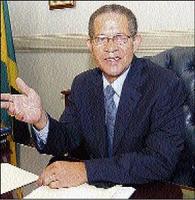
Prime Minister Bruce Golding established a committee to review the libel slander law. - File
KINGSTON (JIS):
Prime Minister Bruce Golding has appointed a 12-member committee to review the country's libel and slander laws, but what are some of the critical issues surrounding the matter?
Mr Golding had ordered the review to facilitate greater openness and transparency in governance with a view to empowering the press to do more investigative journalism. In the Prime Minister's own words, the decision was made to "review the libel and slander law to ensure that it cannot be used as a fire wall to protect wrongdoers."
The view is that a press that is not shackled by excessive restrictions can better perform its duty as the Fourth Estate, protecting the interests of the public and holding the feet of public officials to the fire. A free and vigorous press is a crucial component of a modern democracy.
Wise words
American Founding Father Thomas Jefferson said famously that "were it left to me to decide whether we should have a Government without newspapers or newspapers without Government, I should not hesitate to prefer the latter". On another occasion, he wrote that "once they (the people) become inattentive to public affairs, you and I, Congress and Assemblies and judges and Governors shall all become wolves".
A free and vibrant press is vital to a functioning democracy. But exactly how the press should function vis á vis other interests in the society has been subject to much debate in democratic societies. In the West, there are largely two models which are compared and contrasted: the British model and the American model.
Jamaica and the Caribbean's laws closely mirror Britain's for historical reasons.
The US libel laws are far more liberal than Britain's, says libel law specialist and assistant professor at the School of Mass Communications at the University of South Florida, Dr Roxanne Watson: "The main areas of difference between Caribbean and US libel laws is in the placement of the burden of proof, fault and the requirement to prove actual malice and the recovery of damages".
Proving the truth
Explaining further, she says "libel laws in the US impose a stronger burden of proof on the plaintiff than exist in the Caribbean, since the plaintiff has the burden to prove the untruth of the alleged libel statement and to prove he was injured by the libel. The effect of this has been to place the burden to prove the statement is true on the defendant in libel cases."
The classic case law governing the press in the United States is the famed 1964 New York Times versus Sullivan case in the Supreme Court. In that ruling the US Supreme Court held that for a libel suit to be successful, the plaintiff (the person bringing the suit) has to prove, not just that the statement or statements complained about were false, but that they were published with malice and recklessness.
The fact that the plaintiff may, indeed, have suffered injury to official reputation is not deemed to justify "repressing speech that would otherwise be free", in the words of US Justice William Brennan.
In the United States, the Supreme Court has actually established a Federal rule prohibiting a public official from recovering damages for a defamatory falsehood relating to his official conduct, unless he can prove the abatement was made with actual malice.
It is very difficult for anyone in the US designated a "public person" to be granted damages for libel as the standard of proof of libel is extremely high for public persons. In the US, public persons are defined as Government officials, politicians and entertainment celebrities. (Sometimes the category is very fluid).
The assumption is that by holding certain positions or having a certain status, public persons voluntarily expose themselves to the searchlight and, therefore, cannot claim the same privileges as private persons. (Though the Supreme Court has also stipulated that in certain instances, persons can become involuntary public persons by virtue of certain events and by having positions which give them such prominence and influence in the community as to earn them that designation). In the Caribbean and in Jamaica there is no distinction between private and public persons in the determination of libel suits.
In the landmark New York Times versus Sullivan case, the Supreme Court held expressly that there was a "profound national commitment to the principle that debate on public issues should be uninhibited, robust and wide open and that it may well include vehement, caustic and sometimes unpleasantly sharp attacks on Government and public officials".
Defence or justification
In the Caribbean the burden of proof is on the defendant. Media owners and journalists have to prove the truth of their statements, not that they were made without malice or recklessness. Truth is the defence or justification.
Says Dr Roxanne Watson: "In the Caribbean, while truth or what is referred to as 'justification' is a full defence, in libel actions there is no requirement for the plaintiff in establishing a libel case, to prove that the statement was false - this means that the onus rests on the defendant to prove the statement is true or substantially true."
Dr Watson continues: "However, unlike the Caribbean situation where falsity is assumed and must be rebutted by the person defending against the action, in the United States before a case for libel can be established, the burden of proof is on the person suing to show that the statement at issue was false. Thus in the New York Times versus Sullivan case, the Supreme Court held that requiring critics to prove the truth of their assertions to avoid paying an exorbitant fine, not only suppressed false statement but led to self-censorship."
Explaining the more liberal environment for the press in the United States, Dr Watson further explains : "In the United States, public persons must prove actual malice before recovering punitive damages. In the case of private persons, the standard of proof depends on the category of speech. Thus where the speech is related to a public issue, private persons must prove actual malice before they can recover punitive or presumed damages in a libel action. However, where speech relates to a private matter, private persons need only to prove negligence to recover damages".
In a speech recently delivered at a public forum to discuss issues relating to Jamaica's libel law, chair of the Libel and Slander Review Committee, Justice Hugh Small said: "The Sullivan case is a landmark one, which significantly advances free debate and alleviates the burden of otherwise potentially offensive defamation laws. It has sparked debate around the world and can claim some credit for a relaxation of the strict standard of truth in countries such as India, Australia, New Zealand and South Africa, and most recently in the United Kingdom, as well as by the European Court of Human Rights".
A landmark decision was handed down by the House of Lords in Britain in 2006, which makes it easier for the media to defend themselves against libel. Britain is seen by some as "the libel capital of the world".
Successful cases
In an article titled, 'A New Day in Britain' in the winter 2007 issue of the journal, The News Media and the Law, it was reported that, "Britain's House of Lords handed the media a major victory in October (2006) in a landmark decision that will have a significant impact on libel laws in Britain".
In Jameel versus the Wall Street Journal Europe, the court made it clear that if a media defendant can show that an article or broadcast is a matter of public interest and a product of responsible journalism, the plaintiff cannot receive damages for libel. Under Jameel, journalists in Britain now have a better chance of successfully defending themselves against libel.
In a previous far-reaching ruling, Reynolds versus the Times Newspapers Ltd, there was a moving away from the traditional "plaintiff friendly" libel laws with the court's ruling that the media have a legitimate public interest duty in reporting certain matters.
But some complained that in practice the criteria listed by the court were used to put journalists on trial. Says Media and the Law in the above-quoted article: "Rather than using the criteria as flexible guidelines, the lower courts were applying them as a checklist that must be met in order to use the defence". In Jameel, the House of Lords established that the lower courts had, indeed, been applying Reynolds incorrectly.
So the efforts to reform libel laws is a global one, as countries seek to create more space for the press to do its duty as watchdog, sniffing out corruption and public abuse wherever it is found.


















