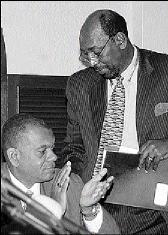
Minister of Health Rudyard Spencer stands to give his address during the National Council on Drug Abuse (NCDA) launch of 10 community clinics for substance abusers and their families at the Knutsford Court Hotel yesterday. Applauding the Health Minister is Michael Tucker, NCDA executive director. - Junior Dowie/Staff Photographer
With some 187,000 Jamaicans addicted to various substances, the National Council on Drug Abuse (NCDA) yesterday launched 10 community clinics for substance abusers and their families.
The aim of the two-year pilot project is to operate a comprehensive intervention programme for substance abusers, children, adolescents and their families at the community level.
The centres will be operated through partnership with community-based non-governmental organisations and tertiary level training institutions.
Breakdown in family
"There is a continued growing concern about family, as breakdown in family life and poor parenting is believed to cause many negative effects on society and health," said Michael Tucker, executive director of the NCDA, during the launch of the programme, at the Knutsford Court Hotel.
He continued: "There is evidence of our youths being depressed, promiscuous, exhibiting behavioural problems, experimenting with drugs, attempting suicide and becoming parents at an early age."
Tucker said the centres would offer targeted interventions, which include professional counselling and support, parenting skills training, life skill training for substance abusers and adolescents and counsellor development workshops.
A referral service will also be available, whereby cases that cannot be dealt with at the centres would be sent to the institutions that provide the help needed.
In his remarks, Rudyard Spencer, minister of health, said all Jamaicans should be concerned about the increase in the number of young people who are using drugs.
Citing the 2006 National School Survey for Jamaica, Spencer noted that it was revealed that an illegal drug was used by 44 per cent of the 4,536 students who were randomly sampled across 70 schools.
High-risk behaviours
He said there was a well-known link between drug abuse and high-risk behaviours such as unprotected sex and crime and violence, which have a significant impact on the public health system.
The health minister said his ministry, in 2001, produced a report which showed that one out of 12 persons with HIV/AIDS had used crack or cocaine.
"It is clear that a successful substance use and abuse prevention and treatment programme would have a positive impact on cross cutting areas such as crime and violence and HIV/AIDS," Spencer said.
The programme is sponsored by the National Health Fund (NHF) to the tune of $11.8 million. Rosemarie Lee, public information officer at the NHF, said any programme aimed at prevention of drug abuse is worth funding. "But it is our view that one of the most effective ways to assist those who have fallen prey to this negative habit is through a programme of support at the community level," she said.


















