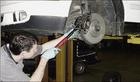
Brake servicing is done at most garages and by competent mechanics around.
Paul Messam, Gleaner Writer
Just as shoes are necessary for our feet, so are the good brakes essential for our motor car. Strong, reliable brakes are of paramount importance. Therefore, in the interest of safety and savings as well as convenience, every driver should have a general idea of what makes the brake work or does not work. Any pull or fade that decreases stopping efficiency is just as hazardous as the braking system that stops operating entirely.
The ironic thing about good brakes is that they are relatively simple to maintain. Brake linings are tough and will provide dependable service for many thousands of miles. There are few moving parts in the system and any qualified auto mechanic can keep it in excellent working order.
Need to know how the brake system works
It is worthwhile to note briefly how a braking system on a contemporary automobile works. Basically, it can be explained in two words: Pascal's Law. Blaise Pascal was a seventeenth-century French mathematician and philosopher who formulated the principle that a change of pressure at one point of a confined fluid is communicated undiminished to all parts of the fluid. In an automobile braking system, the brake lines are filled with just such a 'confined fluid'. When pressure is applied via the brake pedal from a piston in the master cylinder, pressure is transmitted equally to all four brakes.
"Pressure on the brake pedal forces the brake fluid in the master cylinder (the container for brake fluid) through the brake lines to the wheel cylinders to stop the car," explained Andrew Brown, an auto mechanic with over 25 years' experience in the motoring world. "One part of the dual master cylinder connects with the front wheels, the other with the rear wheels," he adds.
According to Brown, a braking system can have both drum brakes and disc brakes. For drum brakes, the pressure of the fluid pushes the brake shoe against the inside of each turning brake drum. On the disc brakes, pads are forced against the turning discs. So friction between these parts slows the wheel down.
Brown further explained that if fluid in one part of the master cylinder leaks out, or a brake line leaks, fluid will not reach one pair of wheels. The other two wheels still get fluid, and the brakes on those wheels will still work. However, stopping the car takes longer.
A steel cable connects the parking brake lever to the brakes on one set of wheels. The parking brake should be able to hold the car on any hill. He pointed out that both disc and drum brakes are self- adjusting. If the brake pedal goes down too near to the floor when you press the pedal hard, drive backward and forward several times. Apply the brake firmly each time to adjust the brakes. If the problem is not corrected, have the brakes checked as soon as possible. "Keep the brake fluid in the master cylinder at the proper level," Brown advised.


















