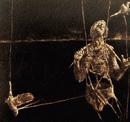

LEFT: 'The Distance Between Us' by Darby. RIGHT: Portrait of Khary Darby.
Khary Darby is an artist living and working in Stony Hill. Here, he discusses his work with Jonathan Greenland.
Can you tell us about your piece, 'The Distance Between Us', in the National Gallery?
That painting is a favourite of mine: It was shown in an Annual National Exhibition, and subsequently acquired by the National Gallery - which was quite a shock for me. It's a large painting, I think, one of a series of self-images, based on rather crude photographs that I took and posed for. I'm not entirely sure how these images come about, but I had been looking at two very important artists - Francis Bacon and Joel Peter Witkin.
Both have often been discussed in terms of the 'darkness' of their imagery and I suppose there is that - but both have produced incredibly arresting images of the body in extreme states of agitation or decomposition. I am not convinced that either had morbid fantasies - but I am convinced that both bodies of work emerge from the minds of deeply neurotic and obsessive individuals.
Your work is known for a similar psychological intensity, darkness and a certain dreamlike quality. Did anything inspire this piece in particular?
I'm not sure what one means by 'inspiration', but I think of this painting as emerging out of an obscure and deeply personal process of manipulation of imagery. I think that the desire to do self-images had to do with my discomfort with the idea that I would be 'exposed', so to speak. I felt that these anxieties could act as a means of agitation, as a way t my response to the images and stir up all sorts of hidden or suppressed emotions, fears and desires. But I have never been able to do the didactic thing, where themes and images have a strictly linear relationship - that doesn't interest me.
Has your childhood had an impact on your work?
I'm not answering that!
You went through a period of selling many works: To what extent have you felt trapped by the marketability of your work?
I've never thought of my work as particularly marketable or market-friendly. For the past five years my work has consisted mainly of large paintings of naked male and female bodies in questionable scenarios - I doubt that the average upper St. Andrew housewife would approve.
Compared to other artists my output has been limited, and I have sold primarily to a few collectors who have more 'adventurous' tastes.
Can you talk us through some of these 'questionable scenarios'?
In my work there is always a kind of tableaux, some kind of a power play happening. It is all about relationships, specifically control and power. But they are always open to questions as to who is actually pulling the strings.
These are things that can be effectively explored in new media, or will you remain a painter?
That's a good question: I think 'new media', as you put it, is quite important and presents many possibilities. I'm very interested in video, film and the broad concepts of various kinds of interactive projects. I do think that these activities need funding if they are going to be developed and that the 'limitatins', if you will, of the Jamaican art audience make them less attractive for many artists to seriously pursue.
What is the significance of angels in your work?
I've never painted an 'angel' in that sort of iconographical sense, as you put it, but I have painted winged figures. These works are, as always, the result of a process of transformation and combination of different source material - photographs, drawings, paintings and so on. From my point of view, the winged entities suggest the natural rather than the mythological or religious. These are common references for me and I suppose the bird imagery has to do with flight, predation or a particular posture or attitude of an animal suggested by human behaviour.
What are your strongest artistic influences, and why?
The European tradition of figurative painting is very important for me: Titian, Velasquez, Rembrandt, and so on. The modern masters, Picasso and Dali, De Kooning and Rothko; the fabulously idiosyncratic Balthus, Lucien Freud and Francis Bacon, there are so many.
In Jamaican art, David Boxer, Carl Abrahams, Colin Garland, Mallica 'Kapo' Reynolds, and so on, there are too many to mention. Film and photography and music have also been very influential.
I have heard people mention your work in association with the Italian Baroque painter Caravaggio. Do you see a link between a baroque style and subject matter and contemporary life?
Yes, but not in a purely visual way. Definitely in terms of the psychology of an artist like Caravaggio - he seemed to have a very violent psychology to me. His works often show decapitated figures and death. I find his work is very fraught with a kind of an angst. In that sense he is very modern. Also, I find his biography to be very modern. And his art is very modern - very paired down, not decorative, not airy-fairy, not idealised, but raw.
You have spoken of a number of neurotic or obsessive artists. Do you identify with that?
Definitely.
What is yourfavourite writing?
Everyone should read some V.S. Naipaul, Gabriel Garcia Marquez and Luis Borges. I think T.S. Eliot was a wonderful poet; he had a great sense of the grand riddle of modern man's existential woes. Also, I find Shakespeare's epic tragedies to be timeless and universal.
Why Naipaul and Marquez?
Everyone should read 100 Years of Solitude by Marquez. There is the strong magical realism, of course, but it is also a deeply pessimistic book. There is this surrealistic element with a dark undercurrent. Generally speaking, I am interested in post-colonial societies in a downwards spiral. I like Naipaul because he was so critical of the Caribbean and the Third World in general. He used harsh words but he was what they call a 'truth teller'. He had no rose-tinted spectacles, no sentimentality. I love that because the Caribbean is not a rose-tinted place.
What do you think of the Jamaican art scene?
The Jamaican art scene is varied and complex, but I think that contemporary art practice in Jamaica is being seriously hampered by a lack of trained critics, historians and theorists in general.
I am not suggesting that the talent or knowledge doesn't exist, it's just that the institutional resources needed to support that kind of work have never really been there.
What is your favourite work?
I have always been in awe of the strange brooding intensity of John Dunkley's paintings.
He was an outsider whose work was fiercely individual and almost impervious to interpretation. Now, that's something to aspire to.
Dr. Jonathan Greenland is executive director of the National Gallery of Jamaica.


















