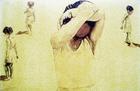
'Innerchild Crossroads'
Michael Robinson, Gleaner Writer
Brands were originally invented in the 19th century to label products so consumers could differentiate between packages on the shelves. Today, a brand is much more than that. A brand is a company's identity and, in many cases, its greatest asset.
Professional artists are not much different from the Fubus, Nikes and other branded products that line display cases in today's consumer markets. Art is a business, an the purists tend to eschew such things as creation for financial gain, the reality is that the work has to sell. It's a matter of survival
Tricia Gordon-Johnston's work is about identity. Sitting in her studio at the first home of what is now the Edna Manley College (EMC), she remembers being at a transitional point last year. Unsure of her next professional move, she attended a panel discussion at the National Gallery. Her 'mentor', Petrona Morrison, was part of the conversation with other art luminaries like Donnette Zacca, Cecil Cooper, Veerle Poupeye and Omari Ra. The talks revolving around the distinction between 'fine art' and 'craft' had a catalytic effect.
"I remember thinking there are endless possibilities," she says. "What resonated with me was the layers and layers of things that we put into ourselves, our work and our identities." She realised then that anything is possible and all that remained was for her to "go to the studio and do the work". She left the National Gallery and went straight to the studio.
Studio space at Great House
As the 2006 recipient of the Institute of Jamaica's Delves Molesworth Award, the 33-year-old EMC graduate was given studio space for one year at the old Great House, formerly known as the Cultural Training Centre. Brainchild of Edna Manley, the centre was originally intended to be a place for artists to learn from one another, while working side by side.
Each morning, she drives from the hills of St. Andrew, through a cross section of social and visual diversity to work side by side with furniture makers, craftsmen and ceramicist Phillip Supersad, who has become something of a fixture at the site. She describes the experience as transformational and describes how it has affected her work. She has started to photograph the urban landscape and include the images in digitally manipulated collages.
The elemental notion of individuality was central to the first series of works produced in the studio owned by the institute. Two panels remain from her 'Colour Wheel' series which investigated primary and secondary colours as components of visible light. Out of many, one.
Gordon-Johnston started creating art somewhere around age four, and later studied the discipline at CXC level. Her full-fledged career would have to wait, however, as she studied business and marketing, even taking a job "for a couple years" in the corporate world. When she got to EMC as a part-time student in 1996, the exposure to various disciplines during the first year encouraged her to think outside the box. "I studied ceramics," she points out her approach to the fusion of techniques, "so painting was never flat to me. I did installations."
Conscious of identity
While her work tackles issues of individuality, she is conscious of her own identity as an artist and as a brand. "The difference between artists and business people is that we don't see ourselves as entrepreneurs," she opines. Creativity is also valuable in business, and the multifaceted painter is also in demand as a stage designer, a graphic artist and an art consultant. Diversifying her product base gives her a more stable financial footing since she doesn't have to rely on any one source of income. It also helps to build her brand.
As an artist, her name is the brand. Buyers, she believes, purchase a name and not merely the work of art. This means, according to Gordon-Johnston, artists have a responsibility to produce consistent quality work. They must also market and promote themselves. It is essential to be selective in submitting the work to galleries and juried exhibitions, choosing opportunities that add value to the brand.
Exhibiting since 2004 in Jamaica and the United States, she has steadily been accumulating brand equity. Her work has graced the walls of the island's two largest galleries. Last year, she was awarded a National Merit and represented her country at Art Miami. The institute's studio-space award was for 'Most Promising Professional Artist'.
She strongly advocates diligence and consistency, even though true success may take years to achieve. "Show up to work every day," she advises young artists aiming to go pro. "Do the work. Submit to galleries and invest wisely." With advances in technology and the advent of the Internet, she suggests staying up to date. "Set up a website and update regularly. That way, people can see what you did last month or last year then go to the gallery and buy your work.
"African [Omari Ra] once told me, 'Work hard for two years. You'll be surprised at what happens.'" Her voice trails off as she reminisces. "Now, here I am, two years later."


















