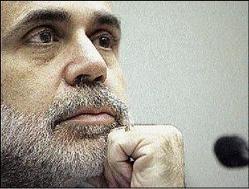
Chairman of the US Federal Reserve, Ben Bernanke. Chances of a US recession are at 50 per cent. - Reuters
Federal Reserve Chairman Ben Bernanke, pledged Thursday to slash interest rates yet again to prevent housing and credit problems from plunging the United States into a recession.
The Fed chief made it clear that the central bank was prepared to act aggressively to rescue a weakening economy.
"We stand ready to take substantive additional action, as needed, to support growth and to provide adequate insurance against downside risks," he said.
Bernanke showed his hand in terms of the Fed's next move amid mounting concerns that the economy may be in danger.
Some economists believe the Fed will slice its key interest rate by a bold half percentage point when the Fed meets next on January 29 and 30.
Sparking inflation
Others, however, think the Fed will go with a more modest one-quarter percentage point reduction, given concerns that high energy prices could spark inflation.
To bolster the economy, the Fed lowered its key rate three times last year. Its last cut, on December 11, left the rate at 4.25 per cent, a two-year low.
Still, Bernanke has come under criticism for not acting more aggressively to deal with the economy's problems.
Worries about America's economic health have gripped voters, galvanised presidential candidates and spurred the White House and Congress to explore ways to stimulate the economy to avoid a recession. The White House is considering a tax cut.
Hiring freeze
Hiring practically ground to a halt in December, pushing the unemployment rate up to 5 per cent, a two-year high, the government said in a report last week, that rattled Wall Street and Main Street.
Bernanke, in a speech to a housing and economic forum, cautioned against reading too much into one report.
However, he said that if employment conditions were to continue to deteriorate, that would raise risks to the economy.
The big worry is that consumers might cut back on their spending, sending the economy into a tailspin.
Incoming information suggests that the outlook for economic activity for this year has worsened and that the "downside risks to growth have become more pronounced," Bernanke warned.
A housing slump, weaker home values, harder-to-get credit and high energy prices all "seem likely to weigh on consumer spending as we move into 2008," he said.
Many analysts predict upcoming reports will show the economy grew at a feeble pace of just 1.5 per cent or less in the final three months of last year and will be weak in the first three months of this year as consumers - major shapers of overall economic activity - tighten their belts.
In light of such risks to the economy's growth, "additional policy easing may well be necessary," said Bernanke.
Former Federal Reserve Chairman Alan Greenspan, who ran the Fed for 18 and a half years, recently warned that the economy is "getting close to stall speed."
Some economists said the odds of a recession are up to 50 per cent.
The housing problems, which are expected to persist well into next year, have unnerved Wall Street. Financial markets remain fragile, Bernanke said.
The situation raises the biggest challenge yet to Bernanke, who took over the Fed in February 2006.
Galloping energy prices - oil recently surged past US$100 a barrel before easing - can put a damper on economic growth and can also spread inflation through the economy if they force companies to boost the prices of many goods and services.
Bernanke acknowledged the situation could complicate the Fed's job of trying to keep the economy growing, while making sure that inflation is under control.
So far, he said, people and companies have "reasonably well-anchored" expectations about where they think inflation will head in the months ahead.
"However, any tendency of inflation expectations to become unmoored or for the Fed's inflation-fighting credibility to be eroded could greatly complicate" the Fed's task of maintaining stable prices, he said.
To help squeezed banks deal with credit problems, the Fed recently created a new auction facility for financial institutions to go to for short-term loans. The Fed in December provided US$40 billion worth of loans to banks and will provide another US$60 billion (euro40.9 billion) in two auctions in January.
Bernanke said these auctions will continue "as long as necessary" to help banks get over credit humps so that they will keep lending to people and companies.
The auctions, Bernanke said, "may thus become a useful permanent addition to the Fed's toolbox."
- AP


















