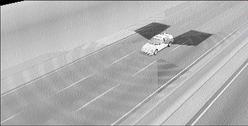
In an illustration provided by General Motors all-around collision warning using traditional sensing is shown. Automakers and parts suppliers are working on similar systems, and GM Chief Executive Rick Wagoner will devote part of a Tuesday speech at the Consumer Electronics Show in Las Vegas to electronically controlled driverless cars. The plan is to use an inexpensive computer chip and an antenna to link vehicles equipped with radar-based cruise control, lane change warning devices, electronic stability control, satellite global positioning systems and digital maps. - AP
Cars that drive themselves - even parking at their destination - could be ready for sale within a decade, General Motors Corp. executives say. GM, parts suppliers, university engineers and other automakers all are working on vehicles that could revolutionise short and long-distance travel.
And Tuesday at the Consumer Electronics Show in Las Vegas GM Chief Executive Rick Wagoner will devote part of his speech to the driverless vehicles.
"This is not science fiction," Larry Burns, GM's vice president for research and development, said in a recent interview.
Obstacles
The most significant obstacles facing the vehicles could be human rather than technical: government regulation, liability laws, privacy concerns and people's passion for the automobile and the control it gives them. Much of the technology already exists for vehicles to take the wheel: radar-based cruise control, motion sensors, lane-change warning devices, electronic stability control and satellite-based digital mapping. And automated vehicles could dramatically improve life on the road, reducing crashes and congestion.
"Now the question is what does society want to do with it?" Burns said. "You're looking at these issues of congestion, safety, energy and emissions. Technically there should be no reason why we can't transfer to a totally different world."
GM plans to use an inexpensive computer chip and an antenna to link vehicles equipped with driverless technologies.
The first use likely would be on highways; people would have the option to choose a driverless mode while they still would control the vehicle on local streets, Burns said. He said the company plans to test driverless car technology by 2015 and have cars on the road around 2018.
Sebastian Thrun, co-leader of the Stanford University team that finished second among six teams completing a 60-mile Pentagon-sponsored race of driverless cars in November, said GM's goal is technically attainable.
But he said he wasn't confident cars would appear in showrooms within a decade.
"There's some very fundamental, basic regulations in the way of that vision in many countries," said Thrun, a professor of computer science and electrical engineering.
Reducing death
The Defense Department contest, which initially involved 35 teams, showed the technology is not ready for prime time. One team was eliminated after its vehicle nearly charged into a building, while another vehicle mysteriously pulled into a house's carport and parked itself.
Thrun said a key benefit of the technology eventually will be safer roads and reducing the roughly 42,000 U.S. traffic deaths that occur annually - 95 per cent of which he said are caused by human mistakes.
Other challenges include updating vehicle codes and figuring out who would be liable in a crash and how to cope with blown tyres or obstacles in the road. But the systems could be developed to tell motorists about road conditions, warn of crashes or stopped vehicles ahead and prevent collisions in intersections.
Later versions of driverless technology could reduce jams by directing vehicles to space themselves close together, almost as if they were cars in a train, and maximise the use of space on a freeway, he said.
"It will really change society, very much like the transition from a horse to a car," Thrun said.
The U.S. government has pushed technology to help drivers avoid crashes, most notably electronic stability controls that help prevent rollovers. The systems are required on new passenger vehicles starting with the 2012 model year. Vehicle-to-vehicle communication and technology allowing cars to talk with highway systems could come next.
Still in debate are how to address drivers' privacy, whether current vehicles can be retrofitted and how many vehicles would need the systems to develop an effective network.
"Where it shakes out remains to be seen but there is no question we see a lot of potential there," said Rae Tyson, a spokesman for the National Highway Traffic Safety Administration.
- AP


















