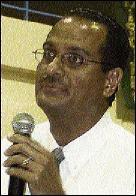
The following is an edited excerpt of a paper presented by the Rev. Paul Hynam of Dove Christian Fellowship, a cell-based church in Barbados, at the Congress of Evangelicals in the Caribbean, held October from 22-25 in Tunapuna, Trinidad. His paper was titled 'The Agency of the Holy Spirit in Discipling'.
In the sporting world, what differentiates great players from good players is the ability to anticipate what your team player or your opponent's next move is going to be. This ability to anticipate or "read the game" is also true of great leadership within the Kingdom of God. It is the ability to discern our present reality, and observing what God is doing, to move in a certain direction expecting or anticipating that such action will significantly advance and bring clarity to the work of God in a given area.
Let's pause and take a bird's-eye-view of what is happening around the world. This information is sourced from Operation World and presented by Joshua Project.
Brazil - From 1992 to 2002, the evangelical population of Brazil doubled. Goals have been set for 250,000 congregations by 2010. More than 100 mission agencies have emerged, sending over 2,000 Brazilian missionaries to 85 countries.
Southern Sudan - In 1960, only five per cent of southern Sudan was Christian. Today, after decades of terrible warfare and persecution, the figure is close to 70 per cent Christian.
In Iran, more Iranians came to Christ between 1980 and 2005 than the previous 1,000 years combined.
Nepal - In the early 1980s, there were only 75 known Nepali believers. Today, there are an estimated 500,000 believers and from almost no churches 20 years ago to more than 6,000 churches and house fellowships today.
Afghanistan - Until very recently, becoming a Christian was very close to a death sentence. Now missionaries in Kabul report unprecedented openness and many new believers in the past three years.
Globally:
Every day another 74,000 people across the globe come to faith in Christ.
An average of 3,500 new churches open every week.
From 1990 to 2000, the number of born-again believers in the world doubled!
As we observe what is being achieved globally, would it be wrong to anticipate that a major immediate global challenge would be intentionally discipling those who come to faith in Christ? Making disciples is the goal; evangelism is not the goal but a means to achieving that goal.
significant growth
As we specifically look at our present situation in the Caribbean, I believe that the Church in this region is beginning to experience the same significant growth that is being experienced in other places. In the midst of our social, political, economic and cultural challenges, we will continue to observe scores of Caribbean people coming to Christ. If we anticipate this, and it will happen, the major challenge will be:
How do we effectively disciple our people in this region to radically affect change?
How can we focus our energy and resources to responsibly prepare for this?
Can we encourage and inspire this great army of people in our pews, who consider themselves to be nothing more than "ordinary believers", to see the exciting potential that is ahead? Is it possible to train and motivate these "ordinary believers" to achieve extraordinary results?
My task this morning is to look at the role of the Holy Spirit in discipling others, and I would like to again look at the life of Jesus and observe how the Holy Spirit was in Him discipling those who became world changers.
When I use the term discipling, I mean establishing a relationship for a given period of time between a more experienced person (the discipler) and another who is being prepared for specific responsibilities (the disciplee).
central theme
Jesus lived and ministered in a specific geographical location, Israel, but had a global perspective, the Kingdom of God. In the Gospels, Jesus makes 87 references to the Kingdom of God or the Kingdom of Heaven and this was the central theme of His preaching and teaching. Whether we accept that this term refers to an 'abstract' idea of God's rule or reign or a 'concrete' idea of the realm over which He will reign, it is universally accepted that the Kingdom of God is not limited to a specific geographical location or people or period but encompasses all countries, peoples, races and spans all generations.
Jesus' repeated emphasis on the Kingdom is a clear indication that a correct understanding of God's power, Gods rule and God's plans in the affairs of men is not optional. This is vital if we are going to be successful in working with Him and working with one another. For once I can grasp the concept of the Kingdom, then your ministry or gifts are not a threat to me or my ministry. In fact, we actually complement and enhance one another. Such revelation can be extremely liberating, and we can have an increasing appreciation for what God is doing nationally, regionally and internationally.
Jesus could therefore grieve over Jerusalem because he understood Israel's divine calling and potential but also how ineffective they had been in realising that potential ... To what extent are we affected by what is going on in the Church regionally?
It is the Holy Spirit who gives revelation and clarity concerning the Kingdom of God. It is the Holy Spirit who can open our understanding and help us 'see' the key role that we have in God's bigger plan of transforming societies.
anointing
Jesus' ministry was anchored in His understanding of the Kingdom of God an He was often viewed as a radical, His popularity and overwhelming success can be attributed to that which was accomplished as a result of His anointing.
There comes a time when we should be able to confidently say like Jesus, "the Spirit of the Lord is upon me because He has anointed me to ..." and know that our words are not idle but are being confirmed with results.
It is important to remind ourselves that such confidence and success is directly attributed to the Holy Spirit's anointing, and not because we are intrinsically good or somehow 'special'. We are special because God has called us and welcomed us as sons and daughters. He did not call us because we were special.
desire
Unquestionably success is attractive. When an individual is experiencing success in a given area of ministry as a result his or her recognised anointing, others will have a desire to experience the same or a similar anointing and the possibility for discipling is created. (These are the people who approach you for assistance.) Anointed gifts and abilities will always create opportunities for discipling others.
However, when we look at Jesus, we see that He also sought to advance the Kingdom by intentionally investing in those whom He chose to be His regular companions, the 12.
Jesus knew that the Kingdom of God encompassed all peoples, races and generations and was therefore investing in these 12 men to transform their generation as well as the generations that would follow.
This strategy is still extremely successful.
'pass it on'
A ministry will only last the lifetime of the one who started it unless there is intentional effort made to "pass it on" to successive generations. Moses discipled Joshua and prepared him for leadership. Elijah took the initiative in throwing his mantle on Elisha and subsequently mentored him. Barnabas initially took Paul under his wing and Paul after many years discipled Timothy and others. Through the generations there have been both men and women who have deliberately "passed on" to others the revelation and understanding they have so freely received with the intention of strengthening and expanding the Kingdom of God.
The challenge facing us in this region as leaders is: "Who are we intentionally discipling?" And if we are discipling or thinking of discipling, can we truly say that our aim is to be actively involved in preparing others to be more 'successful' or more 'anointed' than we are?
role of father
The discipler is not in competition with the disciplee but assumes the role of a father or coach who desires to see the full potential of the disciplee realised. (When we are confident of who we are in Christ, we are not in competition with anyone but we understand that our role is to strengthen and complement what God is doing through others.)
The cry in our region is for spiritual fathers and mothers. Men and women filled with the Spirit of God whose burning desire will be to see sons and daughters, the next generation, assuming leadership roles in bringing change throughout this region.
If this is not our desire, then let us ask God too give us the heart of a father. To give us the heart of a mother. For such a heart was observed in Jesus as he prayed for his companions.
We can only experience true success in discipling others when we get to that place where we are more concerned about the ones that we are discipling than about ourselves and our ministries. When out of a desire to see them being involved in significantly attracting and influencing people and communities for Christ, we continually plead (with God) for them to be successful.
priority
It is the Spirit of God within us that can help us to intentionally consider others before ourselves. Who in this egocentric, success oriented competitive world would give priority to another budding ministry over their own? Only an individual who is filled with the Spirit of God. Only an individual who, like Jesus, would assume the position of a servant (Phil 2). Only a father or a mother who recognises the calling of God in their son or daughter and prepares them for responsible action.
If we can grasp this, then we will understand that our success as disciplers is dependent on the success of those we are discipling, and the generation that follows can have a tremendous springboard towards their God-ordained destiny.
This way of thinking will also make it easier for the discipler to release the disciplee to the ministry that God has called him/her to.
To read the full paper go to http:// www.caribbeanevangelical.org/conecar2007reports/plenarypapers.htm. Send feedback to Mind&Spirit to mark.dawes@gleanerjm.com.
Rev. Paul Hynam of Dove Christian Fellowship, a cell-based church in Barbados.


















