Mel Cooke, Freelance Writer
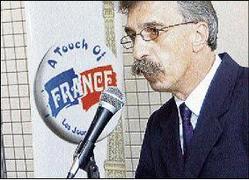
President of Alliance Française of Jamaica Pierre Lemaire.
- Rudolph Brown/Chief Photographer
When head of the Alliance Française in Jamaica, Pierre Lemaire, invited all under the tent at the organisation's Lilford Avenue, St. Andrew, headquarters to take their seat on Monday evening, he noted that they could carry their wine.
"That is the difference from the regular movie theatre," he quipped.
It was not the only one, as the 31st Francophone Film Festival opened with the screening of Stephanie and Steve James' Le Mozat Noir a Cuba (The Black Mozart in Cuba), which surrounds the life of Joseph Boulogne Le Chevalier de Saint-Georges from Guadeloupe.
Flickering torches greeted those who gathered on to the expansive, well-kept grounds, where many moviegoers were first wine tasters.
Noted a difference
And Lemaire, after welcoming the various diplomatic mission heads, noted a difference from previous festivals.
"You see, the problem is that the Francophone Film Festival is growing, so we have to go in alphabetical order," he said. Haiti and Senegal came in for special mention.
"It means we can show the diversity of the Francophone. It is more than showing a language, but to share a concept of culture," he said.
Another difference from a regular movie cinema was the speeches by ambassadors from some of the participating countries before the screening. His Excellency Francis Hurtut, Ambassador of France, complimented Jamaicans on their "intellectual curiosity" and noted that in this era of globalisation "the paradox is that the circulation of individuals seems to be more and more difficult".
Hurtut termed the festival "a unique opportunity to travel without a visa ... and hopefully bring back unforgettable memories and experiences". His Excellency Nafissatou Diagne, ambassador of Senegal, in introducing her country's contribution, reflected on a historical situation where Africans were welcomed to the wars of western countries, but now there are many Africans trying to make a similar voyage who end up in the sea.
Leaving home was also on the mind of Mr. Max Alce, charge d'affaires of Haiti, who said that because of the economic situation many Haitians left the country to work elsewhere. And when he said "there are a lot of Haitians in America and Canada, not in Jamaica", there was laughter.
Sydney Bartley, director of culture, Ministry of Culture, welcomed all the participating Francophone countries to Jamaica, with a special welcome to the ambassador of Senegal "to a country that could be described as a little chaotic. In Jamaica we are proud to be a little chaotic. We are the country where we stand on one side of the road and speak to a person on the other side of the road. And we play dominoes instead of going to work. Or at work".
Bartley also pointed out that "Haiti's work, closing in 1804, was important to our 1807 and was important to America achieving Louisiana from France". He also said that the festival "gives us an exciting alternative to the films we normally get from America".
Brian St. Juste, president of the Jamaica Film and Video Producers Association, urged Jamaican filmmakers to come to the festival as it was not a matter of "just what we do, but that we are exposed to international product so that we become players on the world stage".
"Films like these do not make it to the box office," St. Juste said.
Stephanie James gave some background to 'Le Mozart Noir a Cuba', which was made around a week of activities in Cuba for Saint-Georges. "What was done around him in one week in Cuba has never been done for him in his own country," she said.
Then, before the film was started, there was music, Ann McNamee on piano and Peter Ashbourne on violin doing Saint-Georges' Andanito and Allegro Minore. And there was a final difference from a regular cinema, as the coloured bulbs around the inner edge of the tent were turned off with no advisories about crying babies.


















