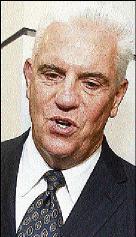
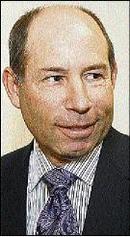
Left: Dole Fresh Fruit Company attorney Rick McKnight declines to comment, saying the case is ongoing. Right: Attorney Duane Miller, who represents banana workers, also declines comment on the Los Angeles County court jury decision Monday. - AP photo
A Los Angeles jury awarded US$3.3 million to six workers on Monday who claimed they were left sterile by a pesticide used at a banana plantation in Nicaragua operated by Dole Fresh Fruit Company, the world's largest producer of fresh fruits and vegetables.
The workers' lawsuit accused Westlake Village, California-based Dole and Standard Fruit Company, now part of Dole, of negligence and fraudulent concealment while using the pesticide DBCP in the 1970s.
The chemical was used to kill microscopic worms on the roots of the banana plants.
The suit also alleged that Dow Chemical Company and Amvac Chemical Corp, manufacturers of the pesticide, knew it could leave workers sterile and kept that information secret.
Amvac reached a US$300,000 settlement in the case before the trial, according to spokeswoman Kelly Kozuma.
The six plaintiffs - whose awards ranged from US$311,200 to US$834,000 - were among 12 workers suing Dole and Dow.
Chemical harmed workers
Jurors in the Los Angeles County Superior Court trial found that the two companies' use of the chemical substantially harmed the workers.
Jurors also found that the risks of the pesticide outweighed its benefits.
Members of the seven-man, five-woman jury awarded the other six plaintiffs nothing after ruling that the companies' use of the pesticide did not substantially harm them.
The jurors, who had deliberated for about three weeks, decided that Westlake Village, California-based Dole would be held responsible for the bulk of the payments.
Jurors were scheduled to return to the courtroom Tuesday to hear arguments on claims that Dole acted maliciously.
If the jurors find against the company, the panel will then be asked to determine any punitive damages against Dole.
Duane Miller, the workers' attorney, refused to answer specific questions, citing the continuing arguments.
"We are gratified with the outcome of the case so far," he said in reference to the plaintiffs who received awards.
Dole attorney Rick McKnight also declined to comment because of the ongoing arguments.
But Gennaro "Gus" Filice, an attorney for Midland, Michigan-based Dow, praised the verdict.
"Dow Chemical Company is very pleased that this jury, after four months of listening to the evidence, concluded that six of the 12 plaintiffs were entitled to no recovery whatsoever ..." he said.
In Nicaragua, the leader of a group of nearly 10,000 former banana workers who has criticised the lawsuits, Victorino Espinales, said he didn't understand why only six workers would receive payments, when thousands were affected.
Espinales previously said Miller wouldn't be able to win the case and encouraged workers to negotiate directly with the defendants.
Hundreds of the former banana workers under Espinales' leadership have been camped out for months in front of the National Assembly waiting for an out-of-court settlement from Dole.
Legal experts have said the case, which lawyers began arguing in July, was significant because it raised the issue of whether multinational companies should be held accountable in the country where they are based or in the countries where they employ workers.
Miller accused Dole in his arguments of improperly applying the pesticide in amounts far exceeding guidelines.
He claimed that Dole chose to spray the pesticide rather than injecting it into the soil or mixing it with ground water as its manufacturer recommended on the product's label.
Miller presented the workers' case with company letters from the 1960s and 1970s that he said showed Dole knew about the problems with DBCP, but wanted to continue using the chemical because the company feared not doing so would hurt their banana crops.
In his closing arguments, Miller told jurors that that the decision to have children was taken away from his clients.
McKnight, meanwhile, had said that the pesticide was only applied once or twice a year and that it was diluted with water and sprayed at night for 15 minutes at a time.
He said the plants were then washed with 56,000 gallons of water for more than an hour afterward. Dole wanted the chemical on the roots, not the leaves, he said.
Dow attorney Gennaro 'Gus' Filice said workers were not exposed to enough DBCP to have any effect. Experts who analysed the exposure found it to have been insignificant, he said.
The case is the first of five lawsuits involving at least 5,000 agricultural workers from Ecuador, Nicaragua, Costa Rica, Guatemala, Honduras and Panama, who claim they were left sterile after being exposed to the pesticide.
Other growers and manufacturers are named as defendants.
- AP


















