Athaliah Reynolds, Staff Reporter
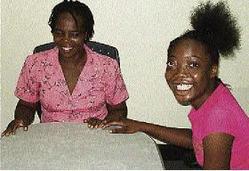
Topas and her mother photo by Barbara Ellington
So it was a shock, to her and her mother, Beverley Oliver, when in 2005 she was told that she might never be able to live her dream.
"I was going to school one day when my head just started hurting," Topas told Flair. She explained that the pain was so intense that she was forced to return home. "In the night I wake up and realise that my eyes swell really big," she said.
Oliver, an office attendant, said she took her daughter to the hospital the following day where she was examined. Following a number of visits to the University Hospital of the West Indies (UHWI) and several X-rays later, Topas was diagnosed with a right orbital pseudotumor - a rare disease that causes the orbit behind the eyeball to become inflamed. Fortunately, it is not cancerous. Oliver said she spends almost all of her salary on her daughter's medical expenses.
"Right now, I owe the hospital over $70, 000 in medical bills and I don't know how I'm going to pay them," she said.
A rare disease
The disease is said to be rare, but can affect anyone - usually females - at any age. It can also be quite painful. Topas said the pain is sometimes unbearable. In addition to the pain, an inflammatory mass (tumour) causes the eye to protrude, which may often restrict the movement of the eye.
Opthomalogist, Dr. Hugh Vaughan, explained that the condition may be treated in various ways. The most ideal he said is the application of oral steroids, which when taken may be able to almost completely reduce the swelling of the eye.
Unfortunately, the medication does have some severe side effects. According to Topas, during her steroid therapy, namely the medication prednisone, she experienced weight gain of almost 50 pounds.
Other side effects include insomnia, increased appetite, swelling in the legs, acne, moon face and decreased immune system which may lead the patient to become susceptible to infections.
The condition can also be treated through surgery. However, according to Dr. Vaughan, this is done only under the most extreme cases.
"Only in extreme cases would surgery be recommended," he said. "In a situation where the individual's sight is threatened, it may be considered, but the risk of surgery is very high".
This is because there are numerous blood vessels and nerves enclosed in the eye cavity that could be severely damaged during surgery.
Option
However, Oliver said that this is the option she hopes to pursue, as she believes it is her daughter's only chance to live a normal life. "They say that there are hospitals in the U.S. that can do it. I just need somebody's help to find out where this is done and the costs," she said. "Because I can't bear to see my daughter in this condition."
The grade 11 (fifth form) student at St. Catherine High School in Spanish Town, told Flair that what has been worse than the pain, is the fact that she is now not able to attend school regularly. Since her diagnosis, Topas misses school at least two days each week. She struggles to keep her grades up and plans on sitting her CXCs sometime next year. Her mother however, fears that because of her daughter's illness, she might not be able to sit her exams.
"She misses school so often that her teacher called me just last week to say that this cannot go on much longer. I am afraid she might not be recommended for her subjects at the end of the year," she said.
As a single mother, Oliver said her daughter's illness has caused her much stress. "I am so depressed sometimes because I don't like seeing her like this."
It was 15-year-old Topas Wilks' dream to become an airline pilot, a career path she has been fascinated with since she was five years old. She is so fascinated with flying, that almost every weekend she goes to Tinson Pen aerodrome to look at the planes and pretend she is soaring high above the clouds in one. She love climbing trees, scaling high walls and riding to the top of high-rise buildings in elevators.


















