Mel Cooke, Freelance Writer
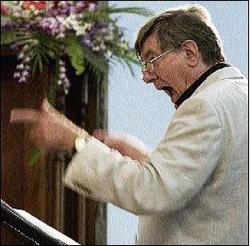
Conductor Michael Burnett guides performers during 'Let These Things Be Written Down', which he specifically composed for the commemoration of the bicentenary of the abolition of the transatlantic trade in Africans. -
photo by Oliver Wright
Voices, combined and in concert, the flute, keyboard, bass and drum combined in Let These Things Be Written Down, a Michael Burnett composition performed at the University Chapel, Mona, on Saturday evening.
And it was a range of voices, as the commemorative event for the bicentenary of the abolition of the transatlantic trade in Africans fused the voices of members of the Methodist Chorale, the National Chorale, the School of Music Choir, Temple of Light and the University Singers for the adult choir. The children's choir was the St. Hugh's Preparatory School Choir and Cantible.
Pauline Forrest Watson and Michael Sutherland stood out up front with soprano and bass, respectively, before the near full house.
Experience
Burnett, a senior lecturer in music at the Roehampton University, London, showed his four-year experience in Jamaica in his choice of material, Dennis Scott, Louise Bennett and Una Marson among those whose work was included in the 12-song composition. And after Fae Ellington's prologue to the work and the introductory fusion of flute and drums, it was Scott's words, along with William Cowper's, that featured in the opening Epitah.
Traditional Jamaican song, Scott's lyrics and the renown "am I not a man and a brother" from the seal of the Anti-Slavery Society were combined in Jane and Louisa, led off by the children's choir, with flute and keyboard coming after a pause and then combining to underpin the song.
A sole male voice sang "am I not a man and a brother?", a female voice enquiring "am I not a woman and a sister?" before the massed male and female voices took up the lines.
Long note
There were no instruments for The Slave Singing at Midnight, the voices climbing to end on high with the final 'bright and free' and soprano led off with 'herdsmen haieing cattle', bass following with the same line, for The Bound, which utilised Derek Walcott's words. Flautist Nicholas Laraque held a long note, gradually increasing to match the volume of the keyboard at the start of Heart Music, then before Brown Baby Blues there was a steady throb of niyahbinghi style drums which then picked up in tempo, one drummer's khaki tam with red, green and gold accents bouncing as he played. The theme line of the concert came up in Hear Music and it would come again.
Traditional song
The short All The Same, a traditional Jamaican song, was the first in a run of three, as the keyboard was lively at the start of Brown Girl in The Ring, the bass voices coming in with authority on one go-round of the refrain, the line also featuring in the emphatic end. Peace and Love was given a plaintive arrangement but the binghi drums were not left out of the traditionally Rastafarian chant, which ended with a high, extended Love to strong applause.
The soprano voice led off the final quarter of Let These Things Be Written Down, the relatively short Horizons of Our Love ended on a rising 'sun'. Soprano also took pole position on I Have Crossed an Ocean, which was also relatively short.
And the extended closing, One People blended many of the songs that had come before, including Jane and Louisa and All the Same, as well as all the voices and instruments, with one girl putting speech in the mix with a snippet from Louise Bennett which ended" … and good duppy walk wid yuh".
And the song, as well as the concert, ended with its title line, to a standing ovation.
Before the drums and flute ushered the other performers out, a copy of the score of Let These Things Be Written Down was presented to Barry Chevannes, chairman of the Institute of Jamaica.


















