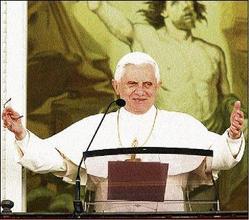
Pope Benedict XVI delivering his message during the traditional Angelus noon prayer from the balcony of his summer residence of Castel Gandolfo, in the hills overlooking Rome, yesterday. Benedict XVI expressed serious concern about the situation in Myanmar and said he strongly hoped that a peaceful solution would be found. - AP
ROME (AP):
A worried Pope Benedict XVI added his voice yesterday to calls for Myanmar's military leaders to peacefully end their crackdown on protesters demanding democracy.
Benedict made his first public comments on the deadly crackdown a few hours after a U.N. special envoy met with some Myanmar government leaders and detained opposition leader Aung San Sui Kyi, whose steadfast, peaceful challenge to the regime earned her the Nobel Peace Prize in 1991. She has spent years under house arrest.
"I am following with great trepidation the very serious events" in Myanmar, the pope told pilgrims at his summer residence in Castel Gandolfo outside Rome.
He expressed his spiritual closeness to the "dear" people of Myanmar during their "painful trial" and he asked the entire Catholic Church to follow his lead in praying intensely for them.
He said he "strongly hoped that a peaceful solution can be found for the good of the country".
Genuine process
Britain's ambassador in Myanmar, Mark Canning, said U.N. Security Council members hoped that envoy Ibrahim Gambari's efforts would help set in motion a genuine process of reconciliation.
Gambari, however, failed to meet so far with the junta's top leader, Senior Gen. Than Shwe.
Canning told Sky News that he hoped that Gambari would be able to remain in Myanmar to get both sides moving.
He said he hoped that new, global consensus about reaching a peaceful solution could push the military government towards reconciliation. Canning was speaking from the country's chief city, Yangon.
Yesterday thousands of troops locked down Myanmar's largest cities. Scores of people were arrested overnight, as the regime sought to further weaken the uprising that aims to end 45 years of military dictatorship.
Protests began on August 19 against hikes in fuel prices, and thousands of Buddhist monks joined what eventually turned out to be demonstrations by tens of thousands of protesters. Last week, government troops opened fire on demonstrators.
The government says 10 people were killed but independent sources say the number is far higher.
As diplomacy continued, Japanese Deputy Foreign Minister Mitoji Yabunaka was expected to arrive in Yangon yesterday evening to further convey international concerns.
Officials have said Yabunaka plans to protest the death of Japanese journalist Kenji Nagai, who was killed in Yangon on Thursday when soldiers fired automatic weapons into a crowd of demonstrators.
Military rule
About 800 Myanmar nationals and 80 Japanese demonstrated in a downpour in Tokyo, carrying banners calling for the end of military rule and the release of Suu Kyi from house arrest, according to Sayaka Miyazawa, an organiser. One demonstrator carried a portrait of Shwe with 'Killer' written above his face.
In Seoul, South Korea, about 300 people, including some 150 Myanmar nationals, demonstrated outside the Myanmar Embassy.
"I miss (home) every day, every minute, every second. Especially when I heard about the democratic uprising in Burma," said Nay Tun Naing of the South Korean branch of Myanmar's National League for Democracy.
Protesters also burned a Myanmar flag.
Neither the protests abroad nor diplomacy so far seem to have budged China, Myanmar's biggest trading partner, into using its influence on the junta as some governments have hoped.
A former U.S. ambassador to the United Nations, John Bolton, told Sky News in Britain that it was time for Washington to put more pressure on Beijing.
Bolton's comments were echoed by Democrat Senator Ron Wyden, a member of the U.S. Senate Intelligence Committee, who told CNN's 'Late Edition' that China needed to become more involved in resolving the crisis.


















