Marcia E. Thomas, Contributor
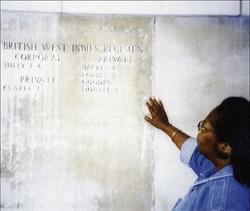
Viewing the names at Menin Gate of the members of the British West Indies Regiment who were listed as missing. - Contributed Photos
Every November, especially when I was a child, little red poppies were sold to aid the veterans of the two World Wars - the men at the Jamaica Legion's Curphey Home.
I have always heard that the poppies represented the blood of the soldiers who fought and were wounded or died on the battlefields of Flanders during the Great War. I knew that many Jamaicans had volunteered to fight with the British Imperial Army. I have seen the memorials at Wolmer's Boys' School and Munro College, with the list of the students who had made the ultimate sacrifice for King and country. I had read that Roy Manley, brother of Norman Manley, died in 1917 in the fields surrounding the town of Ypres (pronounced eeper) in the Flanders province of Belgium.
I have studied the history of the war, read the novels of Earnest Hemmingway and the poems of Wilfred Owen, and seen many films and documentaries on the war. These literature and filmshave been about the British, Canadians, Australians and the Americans (the Doughboys). Nothing much about the nearly 10, 000 Jamaican boys (average age about 20) who served with the British Imperial Army; many of whom died in the cold, muddy, bloody distant fields of Flanders. I have since discovered that there is a book by Richard Smith about the Jamaican Volunteers in the First World War published in Britain in 2004.
VISIT OF A LIFETIME
With an interest in the World Wars, I have always wanted to visit the battle fields in Europe and, particularly, Flanders. Some of the most intense battles were in the fields surrounding Ypres.
A few months ago, I got an opportunity to visit Flanders, which is about an hour's drive from Brussels. I had gone to Brussels to attend a meeting.
When we arrived in Ypres, on an overcast but warm Saturday afternoon in May, we headed directly to the museum in the restored Cloth Hall in the town centre to see the exhibition called 'In Flanders' Fields' taken from the poem by Canadian soldier, John McCrae. As we wandered through the museum trying to see all the exhibits before closing time, my attention was drawn to one particular exhibit about the multinational nature of the war. There, I came upon the Jamaicans.
On the caption entitled 'A multinational war', quoting from the diary of Pastor Achiel Van Wallenghem, it stated: "The locals had their favourites. In May of 1917, some Jamaicans of the British West India Regiment arrived, they were well-mannered and spoke softly."
There it was, the evidence I had hoped to find of the Jamaicans in Flanders. It was exciting. I felt very proud. The Jamaicans were among the favourites with the local people and they had conducted themselves well.
Another great find
After that thrilling find, we left the museum and headed through the town of Ypres to find the Menin Gate - the memorial to thousands of missing men. Their bodies have never been found and there was never a burial. They were justnames on walls maintained by a grateful town.
The town was almost totally destroyed during the war. The allied forces had fought valiantly to protect it from German shelling and invasion. After the war, it was restored using money from Germany's reparation payments stipulated under the Treaty of Versailles. The restoration, which took almost 50 years to complete, maintained the town's ancient architecture.
Today, Ypres is a thriving town in Belgium, the country which hosts the European Commission and the European Parliament, principal institutions of the European Union.
On the massive archway at the Memin Gate, the names of the missing soldiers are inscribed. After a long search among columns listing soldiers from Britain, Canada, Australia, New Zealand, India and other parts of Asia and Africa, we finally found in a secluded corner, the names of six men; Sully, Clarke, Dacres, Forbes, Gooden and Howell - of the British West India Regiment. This was another moment of great excitement. However, I cannot be sure that these six men were all from Jamaica as it appears that the British West Indian Regiment also included men from Barbados, Trinidad and Tobago and British Guiana (Guyana). But it doesn't matter; we found the West Indians.
The great trenches
My trip to Flanders and the Ypres Salient was not yet over. Not far away, some trenches had been found and steps were taken to preserve them. We got directions and headed out of town to find these trenches. World War I was notorious for its trench warfare. The entire countryside of Flanders is criss-crossed with deep trenches in which soldiers spent months, if not years, as they tried desperately to capture or retain a few feet of land from the control of the Germans. The men in these trenches were always cold, wet and muddy, and death was always just a bullet away over the top of the trenches. I now know that Jamaicans and men of the West India Regiment helped to dig these trenches. As black men in the British Imperial Army, they were subject to racial prejudice. They were often assigned the menial tasks of trench and latrine digging. They were support staff. The British continued to doubt that the black or coloured man should be allowed to fight on the frontlines and they feared the consequences for maintaining their power and authority in the colonies.
Driving about 15 minutes outside of Ypres, we found the trenches, one of the many sections of trenches across the region preserved for posterity. With few signposts, we had, in fact, not realised that we had found the site. We saw a man and a young boy and asked for directions, when he informed us that we were directly in front of it. The man told us that he was a digger and was actually the one who had uncovered this sector of trenches. It appeared that the Royal Yorkshire regiment had been stationed in these fields. He told us that just a few weeks before, the bodies of soldiers of the regiment had been found nearby. He said he and his team regularly found masses of ammunition and other artefacts from the war. I have since read on the Internet that it is not uncommon for sections of trenches to be uncovered intact with bodies still in them. They had remained preserved for nearly 90 years in the way they had been left on the day the war ended.
I walked through the narrow trench piled high with sand bags and saw the dug-outs which would have served as quarters for the officers. They were full of water. I was told that it was a daily task for the soldiers to pump water out of the trenches. Now I could understand how miserable the conditions were, how cramped and claustrophobic, and why the men contracted so many infections and diseases. War, indeed, is horror.
As we were about to leave, I saw something red in the grass and looked down to see a small, red poppy. My visit to Flanders on that day last May was complete. I had always associated the artificial red poppies sold, with the Armistice of November 11, 1918, with the old soldiers of Curphey Home (most of whom have now passed on), and with the fields of Flanders. Now, here I was picking a real poppy on a field in Flanders. I will keep this poppy to remember the Jamaicans and the men of the British West India Regiment, who helped to dig the trenches; who served their country in whatever capacity, and those who made the ultimate sacrifice, giving their short lives in the cold, wet, muddy, miserable, and distant fields of Flanders. It is recorded that they served with dignity and honour in the face of all adversities.
Perhaps the red poppy is also a symbol of hope that one day mankind will finally realise that it is better to use peaceful means to resolve conflicts both at home and abroad, and generations of young men (and now young women) will not have to experience war and violence, and will not be maimed and killed for any cause.
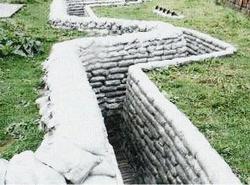
The trenches where so many soldiers gave their lives for the cause.
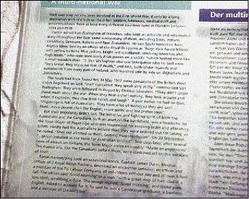
A section of the museum showing the different nationalities that made up the war effort.
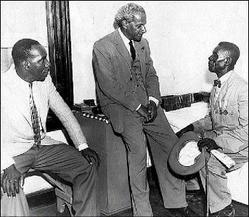
Norman Manley (centre) is seen talking with an ex-serviceman in his bedroom at the Curphey Home for aged and disabled ex-servicemen, after he declared the home open in 1957. Listening to the discussion is Winston Jones.
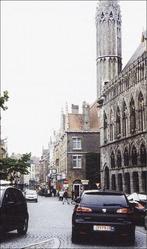
Town centre of Ypres showing the Cloth Hall which houses the Flanders Fields Museum. - Contributed Photos
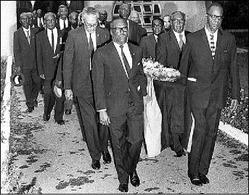
In 1973, one of Jamaica's oldest ex-servicemen, Richard Benjamin Johnson, was buried. Mr. Johnson lived at the Curphey Home for ex-servicemen in Manchester and died at the age of 105. He served in the West Indies Regiment from 1898 and was buried with full military honours.


















