Howard Campbell, Gleaner Writer
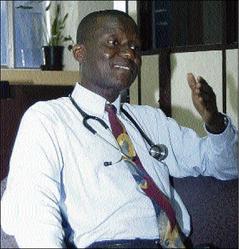
Dr. Bongelo Gombele in office. - Junior Dowie/Staff Photographer
AS HE sat in the lobby of The Gleaner's editorial department, Bongelo Gombele subconsciously toyed with his stethoscope. It took him almost 20 years to earn his medical degree - he wears the instrument like a badge of honour.
When Gombele left his native Zaire in 1983, his future hung in the balance. The country was ruled by the iron hand of President Mobutu Sese Seko. Political unrest forced the 21-year-old to leave for neighbouring Central African Republic where he hoped to complete his medical studies.
Things, however, didn't work out the way he planned.
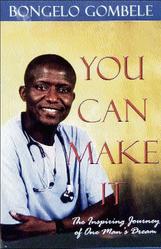
The next two decades saw Gombele making a nomadic trek across Africa, Europe, the Caribbean and Central America before finally settling in Jamaica in 2003. His travels from Zaire (now the Democratic Republic of Congo) in Central Africa to Mexico, where he completed his studies at Monetmoreles University School of Medicine, are chronicled in the autobiography, You Can Make It.
Independently produced, You Can Make It was released by Gombele and his Jamaican wife, Karen, in 2006. The slim, soft-spoken medic said the idea of empowering the marginalised inspired him to write his memoirs.
"It's a testimony to young and old that you can make it once you have focus," the 43-year-old Gombele told The Gleaner recently. "I also wanted to open a window to people of African descent who do not know their African culture."
Medical studies
Gombele's medical studies began as an 18-year-old at the University of Lubumbashi but were curtailed after two years when the despotic Mobutu shut down the country's three universities. From Zaire, Gombele lived in, or passed through, the Central African Republic, Nigeria, Ghana, the Ivory Coast, Chad, Egypt, Sudan, France, Germany and Belgium.
After leaving Belgium, he ended up in Jamaica where he lived for two years, studying at West Indies College (now Northern Caribbean University) and teaching French at Immaculate Conception High School.
Eventually, he went to Costa Rica where he earned a first degree in natural science from the Adventist University of Central America. Later, he graduated from Monetmoreles.
Gombele, a devout Seventh Day Adventist, did a three-year internship at theKingston Public Hospital. He currently practices as a general practitioner at Shalom Medical Centre in Hagley Park, Kingston. It is a far way from the unstable homeland he left behind 24 years ago.
Bongelo Gombele is the fourth of eleven children born to 'humble parents' in the township of Mbandaka. His parents died when he was a child and he says he was raised by an older sister.
At the time, Zaire was one of several African countries under European rule. The country was owned by Belgium and in addition to many tribal tongues, people there also spoke French.
Before conflict became a way of life, Gombele remembered good times as a child in Zaire. Mobutu, who came to power in 1965, is still credited by nationalists with 'Africanising' the country. He renamed it Zaire and removed the European influence from several of its key institutions.
Gradually, the Mobutu regime grew intolerant of criticism. Opponents, or institutions perceived to be anti-government, were suppressed and this forced many of the country's youth and intellectuals to take flight.
After the University of Lubumbashi was closed, Gombele joined the exodus.
"I found it very difficult to function in Africa. Seeing someone in power for many, many years without being reelected bothers me," he said.
He left for the Central African Republic where he hoped to continue his studies. Little did he know that he would log hundreds of frequent-flyer miles before finally securing a medical degree.
Life in Europe was not easy for Gombele. He said he slept in public parks in Paris and throughout the Belgian capital, Brussels, before deciding to travel to Mexico where he hoped for a change in fortunes.
Refused visa
After he was refused a visa to that country, a friend in the SDA church encouraged him to apply to the West Indies College in Jamaica which produced several graduates who had gone on to study in Mexico.
"I knew no one in Jamaica and spoke no English, but I preferred to come here instead of going home," he said.
Gombele arrived in Kingston, Jamaica in June 1989. He said he was fascinated by the city's multi-ethnic populace and the deep affiliation Rastafarians have with the motherland, Africa.
He soon found out that the Jamaica capital was no bed of roses.
When his limited funds dried up, he said he slept in the streets. After his work permit expired, he said he was jailed by authorities for three days and nights in an east Kingston lockup.
There were good times as well. He met Karen while he was teaching at Immaculate and found a hero in the motivational speaker, Dr. Ben Carson, who visited West Indies College in 1991 while Gombele was a student there.
"He came to West Indies College at a most crucial time, when most of the Africans had gone and the few that remained were planning to leave," Gombele wrote. "Dr. Carson explained how he was considered a dumb child while attending primary school. He emphasised that reading was and still is the key to success in his life."
Inspired by Carson's speech, Gombele said he once again saw light at the end of the tunnel. After leaving West Indies College, he left for Costa Rica where he attended the Adventist University of Central America.
Not unique
Dr. Oya Ofori, a Nigerian consultant with the Savanna-La-Mar Hospital in Westmoreland, said Gombele's story is not unique to Africans and Africa.
He told The Gleaner that educated persons usually find it difficult to realise their dreams on the continent.
"It's not easy for many of people. The few that are educated leave (Africa) mainly because of low pay and political instability," Dr. Ofori said.
After 20 years of instability, Bongelo Gombele said he has finally found personal and professional satisfaction. His marriage to Karen has produced two children and he travels around Jamaica giving motivational speeches.
Later this year, he plans to make another long journey by visiting the Democratic Republic of the Congo for the first time in 24 years. He left as a young man with an uncertain future, but will return as the local boy who made good.
- Winston Sill/Freelance Photographer


















