Luiz Inacio Lula da Silva, President of Brazil
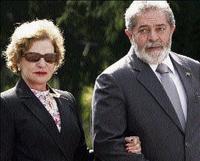
Brazil's President Luiz Inacio Lula da Silva and first lady Marisa leave after paying their respects at the 1846-47 Mexico-U.S. war's monument of the Homeland Defenders in Mexico City, Monday, August 6. Lula was on a two-day state visit to Mexico. - ap
On August 8 and 9, I will be in Jamaica, the first visit by a Brazilian President to this Caribbean country. My visit is to reciprocate the visits by Prime Ministers P.J. Patterson and Portia Simpson Miller, in 2005 and 2006, who were the first two Jamaican heads of state to visit Brazil.
I arrive in Jamaica at a time that is especially auspicious for the relations between our two countries. Many initiatives are under way. We are moving ahead with our cooperation in a wide variety of areas, including tropical agriculture, sugar, ethanol, bio-diesel, sports, tourism and hospitality management.
We will open a new Brazilian Embassy building in Kingston and Jamaica is considering the option of opening an embassy in Brasilia. These advances are more than just symbolic, demonstrating a desire to strengthen our ties. New diplomatic facilities make it possible for us to provide better assistance to our citizens, including Brazilian companies interested in doing business in Jamaica.
Commercial transactions
Our commercial transactions have been growing at an impres-sively rapid rate. In 2002, our annual bilateral trade was below US$70 million. This year, in just the first six months, our exports have already reached US$116.4 million. The problem is that to date this growth has been uneven, in Brazil's favour. In order to correct this trend, we have offered incentives to encourage Brazilian investments in Jamaica and we are offering cooperation, technical assistance, partnerships and financing in areas that offer promise for the economy of this country that is our friend.
In the biofuels area, for example, we now have an exceptional opportunity to raise our bilateral relationship to a higher level, with a great potential for benefiting the people of our countries, but especially the people of Jamaica.
Brazil's more than 30 years of successful experience in producing fuels shows that it is possible to combine energy security with broad economic, social and en-vironmental benefits, without detriment to food production. By adding 25 per cent ethanol derived from sugar cane to gasolene and using pure ethanol in flex-fuel cars, we have reduced by 40 per cent both our consumption and our imports of fossil fuels. Since 2003, we have avoided emissions into the atmosphere equivalent to more than 120 million metric tons of carbon dioxide, thus assisting in combating global warming.
Ethanol job boost
The ethanol industry has already created 1.5 million direct jobs and 4.5 million indirect jobs in Brazil. Our biodiesel programme, still in its initial stage, already employs more than 250,000 Brazilians, mainly small farmers in economically depressed semi-arid zones, generating income and contributing to a better balance between rural and urban areas. Thus the programme addresses issues related to lessening the migration to already overcrowded cities and works to diminish urban exclusion. Biofuels assist in the fight against hunger by generating income that allows poor people to buy food.
The expansion of sugar cane cultivation contributes to the restoration of areas of degraded pasture, which otherwise have little or no agricultural potential.
Ethanol and biodiesel offer genuine sustainable growth options. Aside from creating jobs and income in the agricultural export sector, they open the doors to establishing local biochemical industries that produce technological development and play a value-adding role.
For all these reasons, biofuels have a special significance for the countries of Central America and the Caribbean, such as Jamaica, which has climatic and weather conditions similar to those of Brazil.
Significant role
I offer my congratulations to the Government of Jamaica for the vision it demonstrated when it introduced renewable fuels into its energy mix. I believe biofuels can play a significant role in a global development and environmental conservation strategy. For this reason, the Brazilian government and our business leaders have offered cooperation and technology to all our partners. That is why we offered support in holding a biodiesel seminar in Kingston, the second such seminar organised by the Brazilian government outside of Brazil. Brazil's cooperation with Jamaica to develop ethanol was the first such programme agreed between the Brazilian Cooperation Agency (ABC) and another country.
We have sought to promote tri-angular partnerships with developed countries, in order to increase the flow of funding to new projects in Central America and the Caribbean. Moreover, we are also working to create a global market for ethanol, a market in which this green fuel can benefit the largest possible number of developing countries.
In order to celebrate this new bilateral partnership in the biofuels area, I will participate in the inauguration of an ethanol production plant in Port Esquivel. There, we will witness a union of Brazilian inputs and machinery with Jamaican investment and entrepreneurial spirit. It is an excellent model partnership to be reproduced elsewhere. It is proof that cooperation between Brazil and Jamaica in the area of clean and renewable fuels is already a reality.
Energy cooperation is just one among several examples of what we can do together. We, in Brazil, have much to learn from Jamaica in the area of tourism. Meanwhile, we can pass along our knowledge in economic activities such as tropical agriculture.
New Alternatives
Brazil believes in the potential of South-South relationships, in our countries' capacity to open up opportunities in the international arena, creating ne for the development of our peoples.
We need to consolidate a relationship based on solidarity and open dialogue. In harmony with several of our musicians, who have known how to blend styles, taking advantage of the best of what each country offers to produce new rhythms and sounds, we now face the challenge of joining forces to attain a better future.
It is about these new opportunities that I intend to speak with the Government and people of Jamaica.


















