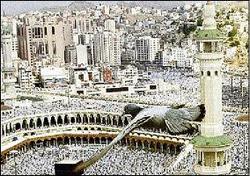
A pigeon flies over the Great Mosque in Mecca, Saudi Arabia, in 2005. Proposals for Islamic houses of worship in several European cities have been shot down by a number of interest groups. - AP PARIS (Reuters):
Petitions in London, protests in Cologne, a court case in Marseille and a violent clash in Berlin - Muslims in Europe are meeting resistance to plans for mosques that befit Islam's status as the continent's second religion.
Across Europe, Muslims who have long prayed in garages and old factories now face scepticism and concern for wanting to build stately mosquesto give proud testimony to the faith and solidity of their Islamic communities.
Some critics reject them as signs of "Islamisation". Others say minarets would scar their city's skyline. Given the role some mosques have played as centres for terrorists, others see Muslim houses of worship as potential security threats.
"The increasingly visible presence of Muslims has prompted questions in all European societies," Tariq Ramadan, one of Europe's leading Muslim spokesmen, argued when far-right groups proposed this year to ban minarets in his native Switzerland.
The issue hit the headlines in Britain in late July when a petition against a 'mega-mosque' next to the 2012 London Olympics site was posted on Prime Minister Gordon Brown's website. It attracted more than 275,000 signatures before it was taken down.
In Germany last month, there were anti-mosque protests in Cologne and Berlin and a local council voted against one in Munich. A French far-right group vowed to sue the city of Marseille for a second time for helping build a "grand mosque".
Bekir Alboga of the Turkish Islamic Union (DITIB) in Cologne said critics who see these new mosques as signs of separatism or of an Islamic colonisation of Europe miss the point.
"The desire of Muslims to build a house of worship means they want to feel at home and live in harmony with their religion in a society they have accepted as theirs," he said.
HIGH SYMBOLIC VALUE
Major mosque projects need years of planning. In the process, Muslim leaders and city officials get to know each other better and most mayors end up supporting them as projects that help integrate the new minority.
But neighbourhood groups and far-right activists, sometimes joined by Christian leaders, have recently spoken out against them as it became clear they would soon have a mosque next door.
The tensions arise because houses of worship have a high symbolic value in Europe, where the cathedral or church is usually the centre of town, said Riem Spielhaus, an expert on Islam in Europe at Berlin's Humboldt University.
"A mosque symbolically retraces the changes that have been made in society," she said. "It reopens the debate on whether these changes are good, whether Muslims should live here, even whether Islam is a good religion."
But this is rarely discussed openly, she said. Disputes about mosques tend to focus on other issues, such as terrorism, the role of women or the availability of parking spots.
Critics of the London mosque, led by a local councillor from a Christian group, argue a large mosque with room for 12,000 worshipers will turn the integrated neighbourhood into a "one-faith zone" driving out followers of other faiths.
Missionaries a risk
They also charge that Tablighi Jamaat (TJ), the Islamic missionaries building the mosque, are a security risk because 'shoe-bomber' Richard Reid and two suicide bombers in the July 2005 London attacks followed the publicity-shy movement.
In Cologne, DITIB's plan for a modern Ottoman-style mosque has met charges it will be too big for a city housing one of the most imposing Gothic cathedrals in the Christian world.
"I have a queasy feeling," Catholic Cardinal Joachim Meisner said. "A mosque would give the city a different panorama. Given our history, there is a shock that Muslim immigration has brought a cultural rupture in our German and European culture."
A mosque project in Pankow, an eastern Berlin area with few Muslims, sparked violent clashes last month between supporters and opponents. Neo-Nazi groups have joined the protests and a truck was torched at the construction site in March.


















