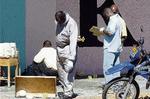
Forensic police searching for clues along Barry Street where a policeman was shot and injured. - Ian Allen/Staff PhotographerCollin Greenland, Contributor
Kudos to The Gleaner and Jacqueline Samuels-Brown for the Letter of the Day published on June 19, bemoaning certain deficiencies of our forensic lab in this land we love. In fact, of all the myriad of articles that has permeated the print media since Bob Woolmer's unfortunate demise, Samuels-Brown's insightful account of her experiences and research on the occurrences of "faulty scientific evidence" was simultaneously the most riveting and illuminating.
The Woolmer fiasco and the Sandals Whitehouse saga had one poignant similarity - Jamaica's inadequacies in the training and application of forensic disciplines - both in the spheres of violent crimes and those of the white collar variety.
The inadequacies of local forensic facilities have been greatly highlighted in matters of violent crime - murders, robbery, arson, etc., but by and large, submissions to Jamaican newspapers on forensic inadequacies pertaining to white-collar crime cases have found little exposure in local press. During the Sandals Whitehouse debates nationally, it was my hope that after the dust settled, more focus would have been on the need to strengthen our forensic departments locally (whether in the Revenue Protection Department, Fraud Squad, Auditor/Contractor General or wherever). Alas, this became (and still is) more of a political football with differing perspectives expressed, seemingly more on political allegiances than prescriptive methodologies for the future.
Case references
Samuels-Brown's letter gave case references and her experiences from the violent crime investigative perspective, which involved "misuse of DNA statistical material;" "misinformation given to the jury" and "shortcomings of the government forensic laboratory." What she may encounter in her white-collar crime cases are similar "shortcomings" in forensic accounting locally. In fact, even worse, she may be further disillusioned to find a "paucity" of forensic services offered locally on the white-collar side of crime fighting efforts.
The Jamaican landscape has seen the proliferation of scandals (real, exaggerated or imagined) over the last few decades, transcending generations and political regimes. The print and electronic media have revelled in the sensational headlines provided by the opprobrium of the zinc scandal (1989 - $500m), the Shell Waiver (1991 - $29.5m), Furniture scandal (1991 - $10.6m), Operation Pride/ NHDC (1997 to 2002 - $5.5b, Public Sector Salaries (1998 - $60m), Net Serv (2001 - $220m), NSWA (2005 - $2b) and Sandals Whitehouse (2006 - $2b), totalling $10.3201 billion, according to one newspaper.
It may be an exercise in futility to continue lobbying for the establishment/improvement in government forensic services (violent or white-collar crimes) in the short or even medium term, regardless of which regime prevails in the upcoming election. But lobby we must! The innumerable demands on our finite national budget, plus their own unenlightenment, for decades have prevented policymakers from both sides of the political divide to prioritise effective, 'cutting-edge' forensic departments.
It may well be that our best hope is for our tertiary institutions to grasp this gap in forensic expertise as a glorious opportunity not only to establish a curriculum that our society is starved of, but also a lucrative niche in selling educational services. Forensic services are in need worldwide, and any visionary house of higher learning that steps up to the plate could provide competent local professionals for future 'Bob Woolmer' and 'Sandals Whitehouse' type cases locally, plus consult elsewhere in the world, earning valuable foreign exchange.
Research by this writer revealed that Finsac paid between 1997 to March 2005 in excess of $527 million in fees to forensic accountants. Not a penny of this, however, entered the pockets of local practitioners. Ernst & Young (U.K.) received over $ 328 million, while Lindquist, Avery, Krol (Canada) pocketed over $199 million.
Larger universities
Conceptually, this 'Forensic College of Jamaica' (FCJ) could be established either as part of one of our larger universities, or deve-loped independently on its own. Its income could be further supplemented by providing forensic services (violent or white-collar crime) to both private and public organisations. For example, In addition to the well-publicised scandals, a multiplicity of government agencies routinely conduct investigations that, due to the perspicacity of the suspects, complexities of the issues, and overall legal intricacies, forensic intervention would be beneficial.
These include, for example, the Revenue Protection Department, Finsac, Tax Payer & Audit Department, Contractor General, Auditor General, Fraud Squad, Parliament's Public Accounts Committee, Director of Public Prosecution, Financial Services Commission, Anti-corruption Commission, Audit Commission, Internal Audit Departments of Ministries/Statutory Body, etc. Except for probably the RPD who conduct some forensic work, the cost of purchasing forensic services abroad prohibit routine utilisation of forensic accounting by these public agencies
Instead of some of the esoterically appealing but investigatively innocuous master's degrees that proliferate these days, this FCJ could instead provide M.Sc. programmes in forensics, with specialities in either white-collar or violent crime. Foundation courses could provide the underpinnings for both options by exposing students to the rudiments of psychology, sociology, criminology, etc.
Forensic science students specialising in violent crimes would move on to do courses emanating from the natural sciences in a myriad of disciplines which could include Criminalistics; Calorimetry (Temperature, Thermomechanics, Thermomagnetics, Macromolecularity, etc.); Mass/ Volume Determination; Density/ Refraction Indices; Glass Properties (Density, flotation, etc.); Soil Properties (Topographical Analyses, Density, Distribution, etc.); Chromatography; Spectrophotometry; X-Ray Diffraction; Neutron Activation; Microscopy (Compound & Stereoscopic); Examination of Hairs/Fibres/Paint); Serology (Blood and Semen Composition, ABO System, Heredity, etc.); Drug Identification; Metallurgical Science; Toxicology; Breathalyzer; Fingerprint (Identification and Classification); Ballistics (Firearm and Toolmark Identification); Combustion Chemistry (Explosive/ Arson Investigation); Casts/Moulds (Preparation and Examination).
White-collar crime
Those forensic science students more interested in white-collar crime would do their advanced courses on Fraud and Forensic accounting, including Advanced Accounting; Internal Audit; Enterprise Risk Management; Corporate Governance; Fraud Examination (Deterrence, Prevention, Detection, Investigation); Cyber/Computer Crimes; Money Laundering; Legal Elements of Fraud (e.g., Law of Evidence, Chain of Custody, Asset Forfeiture, etc); Document Examination (Infrared Electronic Converter, ElectroStatic Detection Apparatus, Projectina, etc.); Computer Forensics and Electronic Discovery (including seizure concepts, disc storage concepts, artefact recovery, crypto and password recovery, cyber-terrorism, internet investigations, digital evidence, etc.)
All this is doable if we have the will, and this will ensure that any future cases of the Woolmer and/or Sandals Whitehouse variety can not only be done by efficient professional locals, but done so speedily, effectively, with accepted credibility and far less controversy. I agree with Samuels-Brown that what we have now is simply 'not good enough'.
Collin Greenland is a certified forensic consultant. He may be reached at cgreeny.collin@gmail.com


















