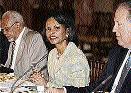
United States Secretary of State Condoleezza Rice sits between Haiti's Foreign Minister Jean-Renald Clerisme (left) and U.S. Assistant Secretary, Bureau of Western Hemisphere Affairs, Thomas Shannon, during the CARICOM ministerial meeting at the State Department in Washington, Monday. - Reuters Linda Hutchinson-Jafar, Business Writer
Washington, D.C., United States:
United States President George W. Bush has agreed to extend the Caribbean Basin Initiative (CBI) which expires in 2008 and will consider expanding it to include additional products for duty-free access, he told Caricom leaders Wednesday.
"The meeting turned out to be better than we expected," said Trinidad and Tobago's Prime Minister, Patrick Manning.
"In fact, the president of the U.S. agreed to extend the CBI arrangement while we sit to renegotiate that arrangement and to update it."
Greater concessions
The pledge would have been pleasing for Jamaican Prime Minister Portia Simpson Miller who, on Tuesday, had urged the U.S. to give the region greater concessions on trade.
But on a more practical level, it would have given companies like Jamaica Broilers - whose movement into fuel grade ethanol production is partially grounded on duty concessions available for exports under the CBI - a lift.
Broilers ramps up its $1.2 billion plant in late summer.
Manning said services and the export of additional petrochemical products such as polyethylene and ethylene and propylene and polypropylene and goods packaged in Trinidad Tobago are issues for the follow-up discussions.
Basic building block
"At the same time, if we're going to be doing ethylene and polyethylene and propylene and polypropylene, it is the basic building block of a plastics industry and a packaging industry, which we are determined to foster," Manning told reporters.
"So, we did put on the table once again, the whole question of goods packaged in Trinidad and Tobago having duty-free access to the U.S. market, and that will form part of the discussions into which we enter as we seek to upgrade the CBI."
He said Trinidad and Tobago as part of the Caribbean is providing a level of energy security to the U.S., which imports about 50 per cent of ammonia, 75 per cent of methanol and just under 70 per cent of LNG from the twin-island state.
Providing energy security
"And indeed, we are providing energy security to the U.S. and we believe that that puts us in a position where we should be getting some consideration for it, " he added.
In the area of human resource development, Grenada's Prime Minister, Dr. Keith Mitchell, said the Caribbean highlighted the need for U.S. support in skills training.
The discussions, said Mitchell, also covered health programmes, economic development and U.S. immigration issues linked to the Caribbean's tourist industry.
"We made the point that we understood the U.S. has its right to implement policies based on what it perceives to be its security interests, but we also asked them to understand the effect it's having on their friends."
business@gleanerjm.com


















