PERSAUD Wilberne Persaud, Financial Gleaner Columnist
Carl Stone claimed his poll results had an error margin of plus or minus three per cent. He was challenged by statisticians and others knowledgeable in social science enquiry. He would not relent, insisting in continuation of the myth that his poll results embodied this particular sampling error.
I tried to set the record straight 10 years ago without mention of this fact. Obviously I failed.
Sampling error occurs because in seeking true characteristics of a population, any population - be it bees in St. Andrew hills, prisoners in the Spanish Townlockup, or potential voters in St. Ann - by study of a sample, there is going to be some degree of 'misrepresentation' because the whole population has not been investigated.
We can reduce, indeed eliminate such errors by increasing the sample size to the point of using the complete population for study of whatever interests us.
For elections, sampling error is eliminated on polling day. The electorate, the voting population, gets its chance to speak.
When we do a political poll in Jamaica, our choice of a sample to ask questions of is normally based on the pollster's understanding of the society in which she/he lives, which hopefully she/he studies and analyses with all the tools learnt in social science laboratories and garnered from understanding of and interactions with the society.
These were Carl Stone's skills.
This kind of analysis and study enabled him to create a group of categories, which he spoke of as 'urban', 'main road', 'rural', 'deep rural' and 'garrison' areas among others. I can't recall if it was Stone who coined the term garrison, but it really doesn't matter.
True representation
The point is, Stone established a set of categories that would allow him to pick groups of people whom he thought would give him a true representation of the opinion of the whole Jamaican voting population.
In his choice of this group - the quota sample - he developed considerable skill. In most cases, the opinions he solicited from them tended to be a fair reflection of what the people who chose to vote actually did in the booth. He was exercising judgment and skill. He was perfecting an art, not a science. He was very good at it, often incorporating 'extra' questions, 'mining' his survey data to allow him to spot and analyse societal trends.
He then described these in his role of public intellectual - speaking and writing in the popular press - and used it to inform further work in his academic discipline.
This is what we lost with Carl Stone's passing. And irrespective of claims to the contrary, no one has as yet filled his shoes.
But why can't we properly and correctly claim a plus or minus three per cent sample error? This error is based on probabilities. Generally because of political volatility, the tendency is not to use the kind of sampling frame that our Statistical Institute, for instance uses in its population surveys. People have grown accustomed to these surveys and there is no difficulty in the subject of interest. Here a genuine random sample is the basis of the survey. To create the categories that would allow an interviewer or enumerator to approach a perfect stranger, go into the markets of Trelawny and Hanover, the streets of Kingston and hillsides of Manchester, solicit opinions and get them without being abused, chased off or beaten, to have those categories be representative of the Jamaican electorate as a whole - these were in my view, the major contributions of Carl Stone to political analysis in Jamaica.
Finally, for polling it is useful to look at the non-sampling errors. Having chosen a 'good' sample, there is the further problem of the nature of the questions, their sequence and whether they will be truthfully answered, whether the interviewer himself introduces bias, et cetera.
These kinds of problems can be severe, disrupting the whole meaning and usefulness of any survey, particularly so in political polling.
Survey questionnaire
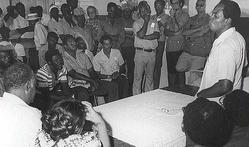
Professor Carl Stone (standing right) is seen here addressing an audience at a cane-cutting ceremony in this 1975 Gleaner photo. - File
For instance, you go into the Trelawny market and administer a survey questionnaire. The lady sits within earshot of friends and even foe. Will the answers to questions of party support be true? Can that person who must be represented in the sample be reached at home for interview in private? Does she live way up in the hills that will cost too much in time and money to get to?
These are the kinds of problems we encounter. They can be solved, however, with skill and money. In the end though, if we want to claim the plus or minus three per cent error margin in our political polling, it would be a good idea for our pollsters to tell us how they construct their sample.
The General Social Survey of the U.S.A., conducted by the National Opinion Research Center with support from the National Science Foundation, uses less than 3,000 respondents to accurately capture data on the U.S. population.
This survey is a mine of information for social scientists. Our own Statistical Institute of Jamaica conducts similar surveys which also provide significant data that our social scientists analyse.
The thing is, the methodology is not hidden. We know with confidence that the error limits disclosed by these institutions are accurate. Would our Jamaican pollsters wish to indicate their sampling methodology? Is it a trade secret? We are not here asking Wal-Mart to share its mother lode of information on its shoppers. And the Jamaican public surely has an interest in being informed.
Finally, the Jamaica Observer newspaper seems to have abandoned the 'new' Stone Polls. This has added a further dimension of complexity to the issue of polls and their claimed accuracy.
wilbe65@yahoo.com


















