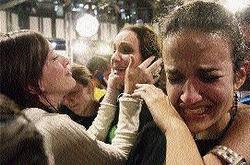
Employees of Radio Caracas Television, RCTV, cry as the channel's signal is cut in Caracas, yesterday, after Venezuela's President Hugo Chávez decided not to renew the the opposition-aligned channel's broadcasting licence. CARACAS (Reuters):
Venezuela's replacement of an opposition television station yesterday with a state network promoting President Hugo Chávez's socialist revolution drew sharp criticism that the former soldier is attacking democratic freedoms.
The leftist leader took the RCTV station off air around midnight on Sunday, silencing a major opponent to reforms that have given him greater control over the judiciary, the military and the oil sector of this OPEC nation.
The European Union (EU) said it was concerned by the decision to replace Venezuela's most popular television station with a new state-backed public service channel, without allowing open competitionand a tender process for a new broadcast license.
"Freedom of speech and freedom of the press are essential elements of democracy," said the EU presidency, currently held by Germany.
Chávez had accused RCTV of showing immoral soap operas and supporting a bungled 2002 coup, along with the nation's other main television stations that saturated the airwaves with often virulent anti-Chávez programming.
But the takeover of the channel dramatically boosts the state's presence in Venezuela's media, with the three main broadcast channels either controlled by the government or largely uncritical of its concentration of power.
Communications Minister Willian Lara was quoted by the El Nacional daily saying the state could investigate news channel Globovision, the last bastion of opposition broadcasting but a network not available over regular airwaves nationwide.
He said a Globovision programme and a survey on the station's website could have counted as incitements to assassinate Chavez.
In a tearful farewell programme, RCTV staff packed a studio and prayed together.


















