Shelly-Ann Thompson, Staff Reporter
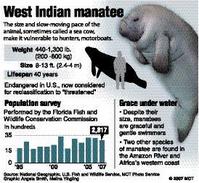
THE NATIONAL Environment and Planning Agency (NEPA) said that there are no plans to downgrade the status of the West Indian manatee (sea cow) from 'endangered' to 'threatened' locally, as is being considered in the U.S. state Florida.
The change in status of manatees in Florida might be attributable to positive growth rates and high adult survival rates along the entire east coast and in the north-west region of the state.
While manatees remain classified as 'endangered' at the federal level, the move comes less than a year after the Florida Fish and Wildlife Conservation Commission voted to reclassify the aquatic mammal on Florida's list to 'threatened'.
Yet, locally, Zadie Neuville, public education officer at NEPA, said that a formal count of manatees would have to be conducted before the animal's status is reclassified.
"We (NEPA) have heard of sightings of manatees by members of the public but we have no formal programme to track and count the manatees," she said.
Currently, NEPA maintains three female manatees in Canoe Valley, Clarendon.
"These are the ones we are sure of. They are trapped by a sandbank, we feed them and take care of them," said Neuville.
Meanwhile, Ishmael Hall, partner of Perfidy's on the Beach eateries and popular fisherman, said that a few more manatees are within local waters apart from those in NEPA's care.
"Seasonally, I see them in Alligator Pond, St. Elizabeth," said Hall. "I mostly see them during the rainy season; the most I've seen at once in that area is four, about a year ago."
Hall, who goes fishing weekly, said that among the four he saw last year was a manatee calf.
"So there must be a male (manatee) in our waters," he said.
Manatees generally measure eight to 13 feet in length.
Manatee Bay, which is between Hellshire and Old Harbour, in St. Catherine, was named for the sea animal because of their former prevalence in that area.
The increasing number of manatee deaths has been attributed to speedboat collisions, water pollution, red tides, alga blooms and habitat loss through coastal development.
Some fishermen allegedly catch the sea cow.
Locally, it is illegal to capture an endangered animal such as the manatee. The fine is up to $100,000 or one year's imprisonment, or both.
Shelly-Ann.Thompson@gleanerjm.com


















