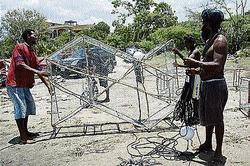
Two fishermen prepare their gear to go to sea. - Photo by Claudine Housen
The Government last Friday outlined a range of measures aimed at resuscitating the local fishing industry, on which approximately 40,000 fishermen and 300,000 others rely directly or indirectly for a living.
Senator A.J. Nicholson, Leader of Government Business in the Senate, speaking in a debate on the state of the industry, in the Upper House, sought to assure his colleagues that the administration was fully aware of the needs of the industry, and those involved and was pursuing appropriate measures to meet these needs. He cited, in particular, the development of a national fisheries policy, and a new Fisheries Act to be enacted this legislative year.
Specific initiatives
As for specific initiatives, he highlighted, among other things, scientific programmes aimed at managing fishing capacity to prevent overfishing, restoring depleted fish stocks, combating poaching (with Brazilian assistance), introducing new methods of growing lobsters under controlled conditions, developing a niche for oyster production, and the possible development of commercial exploitation of the diamond back squid, in collaboration with the Japanese.
Additionally, he said, young men, particularly in inner-city and marginalised rural communities were being trained and provided with financing to start their own backyard ornamental fish operation, as a in some instances, to their struggling marine fishing endeavours.
He disclosed as well that the fisheries division of the Ministry of Agriculture and Lands would shortly be made an executive agency, with a chief executive officer to be appointed by July 1. This, he said, was an important development in the ongoing transformation of the industry to meet 21st century needs and expectations.
The Senate debate on the fishing industry was set in motion by a resolution introduced by Opposition member, Christopher Tufton.
The Tufton resolution (reported on in Saturday's Gleaner) drew attention to the current state of the fishing industry and called for significant state intervention to improve the situation.


















