Kenneth Gardner
Dear Mr. Gardner,
I read with great interest your articles as they appear in The Gleaner.
Your advice helps me in my daily workouts and exercises. There is one subject that I have not seen you address and that is the role of cooling down after exercises/work-outs. Will you please devote some time to this important activity in a future article? Thank you so much.
- Gerald Reece
Dear reader,
Just as it is important to set aside time for warming up before doingany kind of exercise, cooling down is similarly important. Cooling down means gradually slowing down the level of activity which you are currently doing. Generally, this period should last five to 15 minutes and should consist of low-intensity, rhythmical activities and some form of stretching. A proper cool down routine will aid in the following areas:
Prevents venous blood pooling
Increases flexibility
Reduces the recovery time between exercises
Aids in the dissipation of waste products such as lactic acid
Reduces the potential for injury or muscle soreness
Reduces the level of adrenaline in the blood.
Brings down heart rate
Whereas the major purpose of warming-up is to prepare the body and mind for rigorous activity, cooling down is geared specifically to assist in recovery and bringing the body back to a pre-exercise or pre-workout state. After a rigorous bout of exercising or weight training, cooling down will help the heart and breathing rate to return to normal. A general cool down routine will gradually lower your heart rate to between 85 and 95 beats per minute (which is approaching normal resting level).
During a rigorous workout, the body experiences a number of stressful processes. Muscle fibres, tendons and ligaments tend to undergo a lot of strain and waste products build up inside the body. When exercising ceases and waste products like lactic acid stays in the muscles, it may cause swelling and pain. Cooling down after exercising helps to reduce blood pooling by returning the blood to the heart in adequate amounts. The circulating blood also carries with it the oxygen and nutrients required by the muscles, tendons and ligaments for repair and growth.
An effective process for cooling down needs to include three major parts to guarantee a complete restoration of the circulatory system; these include gentle exercise, stretching and refuelling. All these three elements are equally important and none should be ignored or treated as unnecessary. They workin conjunction with each other to repair and replenish the body after exercises. For an effective cool down, carry out a few low- intensity exercises which includes jogging or brisk walking for a few minutes, followed by a stretching routine. Here are a few stretching exercises that can be effectively added to your cool down routine.
Back and hip stretch
Lie flat on your back with arms stretched out to the sides at shoulder level.
Bend knees with feet on the floor.
Lower your knees slowly to one side, while your head turns to face the opposite direction.
Return to centre and lower your knees to the other side.
Hamstring stretch
Sit up straight with legs extended in front of you.
Straighten your back and centre your weight on your buttocks.
Bend knees so that you can loop a towel around your insteps.
Pull on towel as you straighten your legs.
Groin stretch
Sit with weight centred on buttocks, back flat and chest lifted.
Press soles of feet together and let knees fall open.
Place your hands flat on the floor behind your hips to help support your back.
Gently press thighs down and release.
Straddle stretch
Sit with weight centred on the buttocks and slightly forward.
Open legs to comfortable position, knees to ceiling and feet flexed.
Place hands in front of you and press forward gently, keeping spine flat.
Kenneth Gardner is an exercise physiologist at the G. C. Foster College of Physical Education: email: yourhealth@gleanerjm.com.
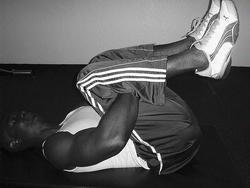
This stretch is really good for the lower back - photo by Daviot Kelly


















