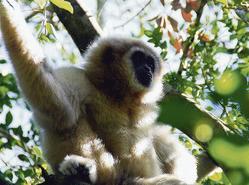
Gibbon monkey from South East Asia sits comfortably in a tree at Monkeyland in Plettenberg Bay, South Africa. - Photos by Janet SilveraJanet Silvera, Senior Gleaner Writer
KYNSNA, South Africa
They fight incessantly, but they don't hold grudges - an exceptional trait that humans could adopt.
South Africa's Monkeyland monkeys are extremely intelligent and protective of their own. Their natural instinct is to steal anything that looks like food, and if it means showcasing skills equalling those of Michael Jordan of American basketball fame, while placing their bodies into your plate to get your sandwich, that's the route they will take.
But, there is far more to their exciting life than pinching food from right under your nose. The more than 300 monkeys, apes and lemurs from all parts of the world find solace in the world's first free-roaming habitat for multi-species.
Previously captive, these primates have found freedom on 25 hectares of a triple canopy forest in Plettenberg Bay, South Africa, where they are rehabilitated and released to spend the remainder of their lives in total opulence, selecting to either feed on fruits, leaves, flowers, herbs, occasional insects or tasty cheeseburgers stolen from the tourists who visit Monkeyland daily.
Most of the animals found at this safe haven were either orphaned, held captive or are old and weak and don't have enough strength to care for themselves.
"They have escaped the rage of poachers, the insolence of insensitive loggers, the zeal of pet traders and the sharp knives of scientists in laboratories," Congolese born Monkeyland ranger and poet, Lazare Kokolo, said of the animals that he has grown to love dearly.
Kokolo, who has studied the species in-depth, say there is a lot to be learnt from these primates who stay in troops, protecting themselves and behaving as if they are in a university.
Place of peace
"They have always pined for a place of peace, an ideal place where they can reunite with their peers and this is what Monkeyland offers them."
As he spoke lovingly of the creatures he has come to know so intimately, Kokolo takes each person that ventures into Monkeyland a lot closer into the minds of the monkeys.
According to him, the common squirrel monkeys that are native to South America, try at all times to enjoy vital rests. "They mark their territory through urinewashing on the trees, to keep their foes out of their surrounding." In the case of the golden-handed tamarin, in captivity - this monkey stays quiet, missing edges and swamps where it enjoys life the most.
While the ring-tailed lemur, whose tail is often turned into a key ring, wishes if it should live 20-25 years without a single predator, would be happy to do it all over again.
Five minutes away from Monkeyland, one of South Africa's big five, the elephant waits patiently for the next tourists to sit on his back.
At the end of a long day, the matriarch of the lot can be quite temperamental and that's the mood leader at the elephant sanctuary - Marula, was in when the Jamaican journalists visited her last Thursday afternoon.
Leading a herd of three on one of her regular safaris, Marula who had a mind of her own, tried unsuccessfully to do just about anything she wanted, reminding trainer/tour guide Zondi Chuma that she was the leader. The constant words, "move Marula, Marula move ... move, Marula move," were enough to get her going.
Weighing an average six to seven tonnes, the huge land-based mammal kept the excitement and sometimes fear in the hearts of the journalists who got their first taste of an aggressive female of that statute.
Rewarded with game pellets at the end of the tour, Chuma explained that whether an elephant is good or bad, it must be rewarded, not punished.
"You don't have to hit them because they have sharp memory and is going to hit you back."
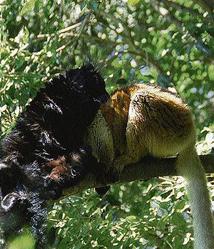
They are called Angelina Jolie and Brad Pitt, the black male lemur monkey and his mate.
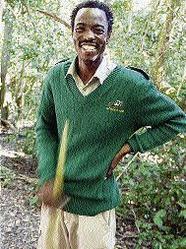
He speaks Italian, French and English fluently. He was forced to flee his homeland in the Congo six years ago. Monkeyland tour guide, Lazare Kokolo, is one of the best 'ambassadors' of South Africa.
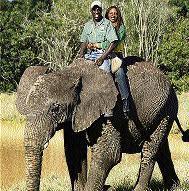
Elephant trainer and tour guide, Zondi Chuma, from Zimbabwe rides the queen of elephant sanctuary - Marula, as he takes The Gleaner's Janet Silvera on a safari tour.
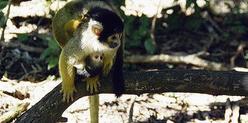
A squirrel monkey feeds her young.


















