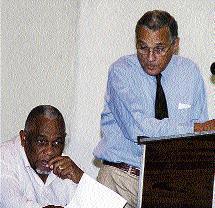
Dr. Richard Jones (standing), chairman of the Coconut Growers Association, gives his annual report at the the Coconut Industry Board Annual General Meeting, held at Coke Hall, East Parade, downtown Kingston, while Errol Ennis, Minister of State in the Ministry of Agriculture and Lands, looks on. - Junior Dowie/Staff Photographer Gareth Manning, Gleaner Writer
The coconut industry is still working feverishly to bring back its tree population to pre-1997 numbers since the outbreak of the lethal yellowing disease.
On the weekend, the Coconut Industry Board, chaired by Dr. Richard Jones, announced that the industry has still been unable to bring the tree population back to capacity under the replanting programme which should have seen a minimum of 100,000 seedlings replanted each year over a five-year period. The Planning Institute of Jamaica reported in its annual Economic and Social Survey that, as at the end of 2006, only 54,138 seedlings were planted.
Failed minimum standards
The industry has failed to meet the minimum standard each year, the board announced, due to farmers' reluctance to plant the Malayan Dwarf and Maypan hybrid seedlings, which are the hybrids still dying from the lethal yellowing disease. The board said that a shortage of Maypan hybrid seedlings, drought, and a lack of younger farmers entering the industry were also cause for the industry's inability to meet the standard.
The programme should have ended in 2004 but will be extended until year-end for the industry to meet the target of 300,000 seedlings. Under the extended programme, the board will continue to offer 60,000 seedlings per year and fertiliser for 80 per cent of the seedlings free of cost to qualified farmers. A weed control grant is also to be made available.
The programme will cover the parishes of St. Thomas, Portland, St. Mary, St. Ann and St. Catherine.
To qualify, farmers must be registered with the Coconut Industry Board and must have land to accommodate at least 125 coconut seedlings.


















