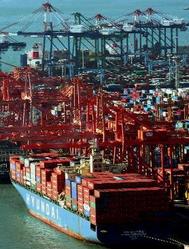
A port in Pusan, southeast of Seoul, is seen in this picture taken Monday. The United States and South Korea agreed the biggest U.S. trade pact for 15 years on Monday with only minutes to go before a deadline. - Reuters (Reuters):
The United States and South Korea agreed the biggest U.S. trade pact for 15 years on Monday with only minutes to go before a deadline.
In one major surprise, the United States agreed to give, at least in principle, preferential treatment to South Korean products made in North Korea.
The deal to cut tarriffs and remove trade barriers follows nine months of talks and sometimes violent protests in South Korea, mostly over fears that the country's heavily subsidised farmers could not survive a flood of cheaper U.S. farm products.
"We expect the ... (agreement) would provide a stepping stone that would catapult Korea into an advanced economy," a press official quoted President Roh Moo-Hyun as saying.
U.S. negotiators were equally enthusiastic.
"In the agricultural sector, you're going to see substantial new market access for America's agricultural producers in a fast growing, wealthy market ... it's a great deal for America's farmers and ranchers as well," Deputy U.S. Trade Representative Karan Bhatia told reporters.
Seoul agreed in the end to phase out its 40 per cent tariff on U.S. beef over 15 years, but did not budge on the most sensitive, and heavily protected, farm product - rice, something Bhatia said he wished had been included.
Level playing field
On another major sticking point, the two agreed to open their markets more to each other's autos.
"We have in this agreement an unprecedented set of provisions to help ensure that American automobile manufacturers ... will gain a level playing field that will allow them to do so," Bhatia said.
The accord between the United States and Asia's third-largest economy was struck just minutes before time ran out for the White House to use legislation allowing it to present a deal to Congress that can be rejected or accepted, but not changed.
Some estimates say an agreement could add US$20 billion to the already more than US$70 billion of two-way trade each year.
In the talks' big surprise, the United States agreed in principle to give certain products from North Korea preferential treatment. That would accede to South Korea's request that goods it makes in an industrial park just insideNorth Korea get similar treatment to those made at home.
The United States had previously balked at the idea following North Korea's missile and nuclear tests last year.
The agreement comes with conditions, including progress in talks to end North Korea's nuclear weapons programme.
U.S. President George W. Bush, in a letter to Congress released by the White House, said agreement would bring export opportunities for a range of U.S. businesses, promote economic growth and provide jobs.
"(It) will also further enhance the strong United States-Korea partnership, which has served as a force for stability and prosperity in Asia," he said.
LAST-MINUTE HAGGLING
Much of the final bargaining focused on whether the parties could concede enough to each other on farm goods and cars, with both sides seeking lower tariff and other barriers to auto imports.
The two both agreed to open up their markets to each other's autos, a move which auto analysts say will largely benefit South Korea.
Expectations that the two sides would strike a deal helped boost South Korea's stock market to a five-week high, especially auto stocks.
Negotiators had seemed on the verge of a deal after Bush and Roh agreed last week to instruct negotiators to be flexible.
But last-minute haggling meant missing two self-imposed deadlines over the weekend.
The trade agreement had to be with Congress by the end of Sunday Washington time (0400 GMT) if it was to meet the 90-day required notice period. If they had missed that, talks would likely have dragged on for years.


















