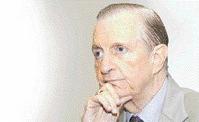
Edward SeagaNewspaper editorials are supposed to be quotable as the ultimate in sober and accurate advice. The views expressed in editorials are often quoted to settle arguments or find the best direction for the next step.
I was surprised to read an editorial in the Wednesday, March 14, issue of The Daily Observer championing the type of leadership that is willing to dream visions and "run with it" regardless of whether we can afford it or not. One of the reasons for Jamaica failing to sustain the economic strength which it has achieved periodically is precisely because prudent policies are usually replaced by policies of spending what the revenue does not have in order to satisfy a 'vision' or a 'dream'.
The editorial goes so far as to encourage government "not to be deterred by those who can't catch the dream".
The issue in question here is the building of fly-overs to deal with Kingston's run-away traffic problem. Having a dream is no achievement; financing them is. Populism is, in essence, spending what you don't have, just as socialism is spending what others have. Both ways are wrong.
There are good examples in Jamaica which will support this Conclusion.
In the 1970s, the Michael Manley-led Government was a perfect example of erratic spending which drove the economy to ruins. The announcement of "free education" in the budget session of 1973/74 was one of the most notable cases about which everyone should be made aware.
Presentation unravelled
In the budget debate of that year, I spoke as shadow Minister of Finance. My presentation unravelled the neatly packaged budget showing the realistic position by unwrapping the pretty tissue paper cover to reveal the fake content.
In reply, Manley felt that he had to recover ground and he did so in an extraordinary manner. He decided to offer the country "free education" for all students of secondary schools and those in tertiary education. What a marvellous package! The only problem was that neither the Ministry of Finance nor Education had a chance to work out the cost based on the sudden decision. He did not promise to set up a task force to determine the cost of financing this ambitious dream. He announced its prompt implementation so that it would become effective immediately "for the first time at last".
In the budget of the following year the cost of "free education" was set out. The expenditure had moved from $47.75 million in 1972/73 to $209.00 million in 1973/74. By implementing this dream, the secondary schools realised that they would be unable to cope with what government was giving them to operate the schools in lieu of school fees. So they charged students a variety of non-academic fees defeating the real purpose of "free education".
In the end, the "free education" for tertiary students had to be scrapped, followed eventually by the "free education" for secondary schools.
Meanwhile, carrying the cost of "free education" became one of the factors causing the budget to show huge deficits annually for many years, peaking at negative 22 per cent of GDP in 1977, one of the highest levels worldwide.
Free education in secondary schools is a most desirable achievement. I have championed it, but only when the economy was at a point where the removal of school fees would have been, in today?s terms, of little significance to the total budget expenditure.
Economic mistake
Michael Manley, who had a tendency to go off the deep end in pursuit of visions, repeated the same economically shattering mistake in 1991 when he withdrew application of the Exchange Control Act governing the transfer of foreign exchange overseas. He allowed himself to be convinced by persons with self-interest that this was the right thing to do to attract the flow of huge sums of foreign exchange into Jamaica. At that time, the Bank of Jamaica had a negative Net International Reserve balance which was being decreased annually by amounts which would produce a positive balance by 1993/94.
Once a reasonable positive NIR balance was achieved, the Bank of Jamaica would then be in a position to protect the value of the Jamaican dollar from any flight of capital which would take place on the announcement of the removal of exchange control.
Instead of waiting a few years for this positive NIR to develop, he removed exchange control prematurely with the result that the only vision that was realised was that of a massive capital flight of dollars taking wings out of Jamaica. This caused the exchange rate to jump from J$13.97 to J$21.59 to US$1 over three months September to December 1991. That was the beginning of the meltdown of the economy in the 1990s.
The impact was disastrous on the economy.
Now that lessons have been learned all around and the Minister of Finance is endeavouring to achieve a prudent financial framework, it does not help to have authoritative sources encouraging a policy of 'run wid it'.
It is perfectly true that the traffic situation in the Corporate Area is as entangled as a bowl of spaghetti. When the Highway 2000 project was announced I issued a statement that the problem of getting out of Kingston would first have to be solved or there would be little saving in the overall time on a trip on the highway to Mandeville.
Untangling the traffic problem in the Corporate Area should be in the next major traffic project, but only when the Minister of Finance says that he is able to do so on a properly financed basis which will not set back the economy. The cost of the solution to this problem was stated to be US$100 million seven years ago. At present, it might be double or treble that amount costing J$6.7 billion to J$13.4 billion.
This is obviously an amount of expenditure that would require the most serious consideration for financing. Let the Minister of Finance have the time tosort it out on a proper basis.
■ Edward Seaga is a former Prime Minister. He is now a distinguished fellow at the UWI. Email: odf@uwimona.edu.jm



















