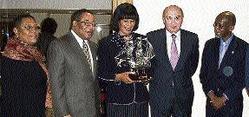
Prime Minister Portia Simpson Miller admires a replica of the 'Nina', the historic ship on which explorer Christopher Columbus sailed to Jamaica in 1494, which was presented to her by Director General of the Spanish Confederation of Entrepreneurs Organizations (CEOE), Jose Maria Lacasa (second right), in Madrid on March 6. Also with them are (from left), Permanent Secretary in the Office of the Prime Minister, Patricia Sinclair-McCalla; Foreign Affairs and Foreign Trade Minister, Anthony Hylton; and non-resident Ambassador to Spain, Burchell Whiteman. The Prime Minister is in Spain as part of a four-nation European tour. - Contributed Prime Minister Portia Simpson Miller says Jamaica remains committed to the ideals of the African, Caribbean and Pacific (ACP) group of countries, notwithstanding Europe's insistence on negotiating regional trade and cooperation agreements with ACP members rather than maintaining the omnibus pact of the past three decades.
Simpson Miller, currently on a tour of Europe, addressed the ACP Committee of Ambassadors at the organisation's headquarters in Brussels on Monday, telling them that she was aware that the more than 70-member group was at a crossroads and in danger of polarisation.
ACP principles
But her country, the Jamaican leader said, believed that maintaining the ACP, and the principles it has propounded since it first signed a trade and aid agreement with the European Union in 1975, continued to be important.
"I am very aware that we all share a common but powerful bond of history, kinship and lasting friendship,which has united our group for the past 30 years," Simpson Miller told the ambassadors. "Jamaica attaches great importance to its intra ACP relations."
What was now important, the Prime Minister said, was how the group responded to the changing environment, including its relationship with the EU.
The ACP is yet to clearly define its future role, but there is consensus that it should remain as a distinct umbrella body providing some level of cover to the so-called regional Economic Partnership Agreements (EPAs) being fashioned by its members with the EU. At the same time, the ACP with its large number of developing countries as members remains a potentially influential bloc in global trade negotiations.
In fact, the Jamaican leader Simpson Miller stressed the need for continued ACP solidarity in the World Trade Organisation (WTO).
The issue faced by the body is how to maximise these potential strengths, and Simpson Miller said that the group had to confront its less than adequate political dialogue on the issues.
"Jamaica is concerned that hot-beds of tension and hostility within and between ACP states should be resolved as quickly as possible," she said. "It's a simple fact, countries at war are not countries in development. Countries in conflict are undermining the development of their own people."
Seek solutions
Member countries engaged in conflict should seek durable solutions, using the ACP and other friendly states as well as regional organisations and the United Nations.
The ACP should commit to ensure that the resources from all member states are used to the service of not only their own people, but also across the ACP states.
"Indeed, we are partners in development, linked by our shared commitment to the UN Charter, the Millennium Development Goals and the Cotonou-based relations with the EU," she said.
The ACP states, the Prime Minister said, possessed people of talent with the capacity to contribute effectively to the search for solutions to the global threats to peace, development and security.
"We have the human resources which must be developed and effectively utilised to that end," she said.
business@gleanerjm.com



















