
Laura Tanna
Buenos Aires is fabulous! South American seasons are the reverse of ours; I picked November to enjoy spring and was rewarded with jacaranda trees blooming in purple profusion throughout this city of three million in central Buenos Aires, 12 million in the capital's metropolitan area. We are directed to a Manuel Tienda Léon desk after clearing customs with our luggage at Ezeiza airport and use their efficient van service several times during our 10 days in Argentina.
Often I'd read about the Alvear Palace Hotel in Recoleta, Buenos Aires' most elegant neighbourhood. Built in 1932, the hotel reflects the city's golden era when the grains and beef of the pampas fed the world in the late 19th century. The lobby is two storeys high, with beige marble, chandeliers, regal blue and gold curtains and carpeting, burgundy velvet French antique gilt furniture, potted palms and tiers of fresh flowers throughout. The service is both absolutely impeccable and refreshingly warm, none of the stuffy pomposity too often associated with places of such elegance.
Doorman Jorgé Flacco becomes an old friend by the time we leave. Breakfast in L'Orangerie is a splendid affair, reminiscent of breakfast on the terrace of Hotel Splendido in Portofino. Smoked salmon, scrambled eggs, bacon, ham, sausage, under silver-domed dishes, all manner of breads, fruits, cereal and served at the table, excellent coffee and fresh orange juice. Our fellow diners are equal parts businessmen in suits and ties or polo enthusiasts in T-shirts and jeans.
Historically Buenos Aires grew inland from the mouth of the Rio de la Plata. Original inhabitants, the Querandi, annihilated the Europeans who first landed in 1516. In 1536, Spanish settlers with soldiers arrived, but Spain abandoned the area in 1541 to colonise inland. But 1580 finally saw Buenos Aires as an official Spanish settlement, though with only 500 inhabitants by 1610. Spain eventually, in 1776, created a Viceroyalty of the River Plate, comprising what is today Bolivia, Paraguay, Argentina and Uruguay. Subsequently the port boomed and European migration began in earnest. England, in 1806, and again, in 1807, invaded but was repulsed. On July 9, 1816, Argentina declared itself an independent nation from Spain. With a history far too complicated to delve into here, Argentina is still a Spanish-speaking nation, but Argentina's population of almost 40 million reflects an ancestry of some 60 per cent Italian from later migrations, 30 per cent Spanish, with the remaining 10 per cent including English and Russian-Jewish refugees, and a small percentage of native Indians.
Fabien at the Alvear's concierge desk recommends a half-day city tour with an English-speaking guide for US$25 per person, maximum 10, in an air-conditioned van for an introduction to Buenos Aires. The friendly visit guides have university degrees, and our guide, Susana Epel, an architect, was superb. She explained that southern Buenos Aires developed around the port with relevant commercial activities, central Buenos Aires became the financial and administrative sector and the north is primarily residential - very much the way Kingston developed - but with a population twice that of Jamaica in the central region alone, you can imagine how many different neighbourhoods there are to explore.
Catedral Metropolitana
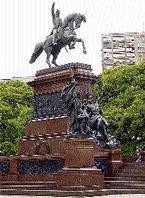
Left: Equestrian statue of General José de San Martin.
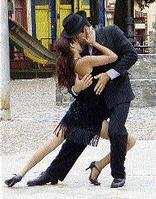
Right: Tango dancers near Caminito.
Plaza de Mayo, opposite Casa Rosada, the Presidential Office Building, originally appeared faint pink since ox blood was traditionally mixed into the whitewash to protect the clay surfaces. Now the front is vivid rose. Some claim Menem's government in the '90s ran out of funds before completing the project, others that the movie company producing Evita with Madonna enhanced the façade for better filming and never restored the original shade. Across the plaza stands the beautiful white Spanish-style mayor's office. On the plaza's side is Catedral Metropolitana in neoclassic Greco-Roman architecture, 12 huge columns for each of Jesus' apostles facing the plaza. Thursdays at 3:30 p.m., Mothers of the 'Disappeared' still walk here in
memory of those killed under a military dictatorship three decades ago. Occasionally one sees graffiti, Nunca Mas (Never Again).
Buenos Aires is fascinating, with all the human warmth of Italian culture and all the elegance of French architecture, nowhere seen better than in Retiro, near Plaza San Martin. An equestrian statue of the liberating general dominates the plaza, temporarily covered in metre-high colourful hearts. That's right. Artists have followed a world trend, creating works which decorate a city and then are auctioned off for charity - in this case for a cardiology foundation.
Father of modern Buenos Aires, Torcuato de Alvear, served as municipal head from 1883-87, and inspired by Haussmann, remodelled parts of the city in Parisian style. The nearby Ministry of Foreign Affairs is recognisably French, as is the French Embassy. Florida Avenue leads off this plaza, providing a pedestrian shopping zone, especially for stylish clothing and leather goods. Galerias Pacifico, one of half a dozen modern Buenos Aires indoor malls, has murals on its vaulted ceilings worth viewing.
La Boca sounds familiar to soccer lovers because much-loved Diego Maradona came out of this poor area, playing first for Boca Juniors. Visitors love Caminito Street because of the artwork, craft, and cafes on cobblestone lanes surrounded by wildly colourful houses. Yes, even with zinc-sheet walls. Tradition is that poor migrants off the ships at the mouth of the river used whatever paint they could find left onboard. These tenements provided a cauldron for the creation of the tango, that fusion of African, Spanish, Cuban rhythms in the 1860s, danced on the street or in houses of prostitution, deplored by the Catholic Church until Europe fell in love with the tango in the early 20th century, liberating it back home.
El Viejo Almacen at 10:00 p.m. is a favourite place for tango shows, though mind your possessions in this area at night. Also, in nearby San Telmo, equally quaint with many antique shops but near poorer areas.
Argentina suffered a major economic crisis in 2001 when the country defaulted on a US$150 billion debt. Bank accounts were frozen, currency devalued and an estimated 280,000 Argentineans, many middle-class, have migrated. We know how devastating that scenario can be. The Miami Herald estimates 3,000 children now live on the streets. Families come at night to collect refuse to recycle. The streets are astonishingly clean and though we are constantly told to take radio taxis, which are inexpensive, wherever we do walk, we feel comfortable. People are incredibly nice. Despite this economic setback, Argentina has free education for all, from primary through to tertiary, and economic stability has returned, with an exchange rate of three pesos to US$1.
If one remained in Recoleta with its five-star hotels, and famous cemetery where Eva Peron and other celebrities are buried in tombs of great elegance, or in Palermo, a visitor would think Buenos Aires totally First World. Here one finds MALBA, the Museum of Latin American Art, housing architect Constantini's collection. He created and donated the huge metal-sculptured six-petal flower which automatically shuts at night. The National Museum of Fine Arts is the one I favour, with European art, including Impressionists, and fine 19th and 20th-century Argentinean painters.
Buenos Aires is incredibly rich culturally, I mean. RICH. Scores of museums, galleries, sporting, dance and musical events fit any and everyone's taste. Sadly, Teatre Colon just closed for two years refurbishment, to be ready for its centenary in 2008 but operas are still performed in La Luna, Buenos Aires' equivalent of Madison Square Garden. (Our guide remembers the thrill of seeing the Harlem Globe Trotters basketball team there).
Palermo's gardens enchant us, especially in November when the Rose Garden blooms pink against blue agapanthus and ever-present purple jacarandas. We walk from our hotel throughout the gardens on a sunny afternoon of great beauty. Dozens participate in an aerobics class, others play soccer. In the Japanese Garden with a traditional humpback bridge over ponds of fish, carefully placed stones, manicured plants, photographers film a soap opera of lovers kissing in the park!
Of course, there's a zoo and Argentineans are so artistic, there are sculptures citywide. Almost as English as the gardens is the love of dogs. Argentineans have the most wonderful-looking pets, which they take everywhere. Palermo Chico is the chic residential area with many embassies, Palermo Soho the trendy counterculture part of town. One night we eat Vietnamese food at Green Bamboo, an all-black room, green mural of the Mekong river above the bar dominated by a red portrait of Ho Chi Minh. Guide books tell gay visitors places where they are welcome and though I'm one for tree-lined streets, museums and gardens, I would be remiss if I didn't mention the neighbourhood all Buenos Aires talks about.
Puerto Madero evokes London's Docklands or San Francisco's Ghiradelli Square. Red-brick warehouses along a port built in 1880, now superseded by a larger port farther north, have been gutted inside to provide shops, cafes and restaurants riverside. We dine at Cabana las Lilas, a popular steak house. Mario at Mac's Chop House will be delighted that we found his filet mignon au poivre much better! Though at three times the price as in Argentina. The best steak we have is also in Puerto Madero attending the cabaret Tango Rojo, at FaenaHotel+Universe, a Philippe Starck-designed hotel inspired by Alan Faena recreating the Belle ƒpoque of Europe, emulated in Argentina in its wealthier past. Too over the top for me, but the food, wine and tango are great and more modern types will definitely want to check out their bar.
Another day, we have a great Japanese lunch at SushiClub. The 25-40-year-olds working in the financial sector just north love this place, confirming that Puerto Madero is yuppie heaven for many up-and-coming young Portenos! Oh, I have to tell you about Piegari, in La Recova, everyone else will. The excellence of their Italian cuisine is surpassed only by the staff's graciousness - a really warm, family feel. Cafe Tortoni, another must, opened in 1858 and remains Buenos Aires' most venerated old-world coffee house. There is just too much to tell you about the Argentine capital.
All I know is that we fell in love with Buenos Aires with its Italian warmth, French architecture and Latin culture.