Gareth Manning, Sunday Gleaner Reporter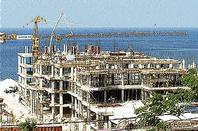
Construction taking place on the 980-room five-star Grupo Iberostar Hotel in Rose Hall, St. James. - Claudine Housen/Staff Photographer
Some resort towns have exceeded the level of development recommended by the Tourism Ministry, raising fears among environmentalists and officials that the infrastructure is coming under strain.
Respected government agencies have failed to adhere to the guidelines of the tourism master plan, The Sunday Gleaner understands, because there is no single agency mandated to enforce it. The plan is aimed at encouraging sustainable tourism development by balancing growth with environmental sustainability. But failure to follow the guidelines of the plan has resulted in the approval of a number of massive hotel developments in areas where those hotels will put serious strain on the environment.
Tina Williams, director of tourism facilitation in the ministry, said its policy document - the tourism master plan - had recognised that there were certain areas where hotel development had exceeded or was close to exceeding its limit. Consequently, the Tourism Ministry made recommendations in the master plan to ensure development takes place within a prescribed carrying capacity.
"(In) places like Ocho Rios, we had realised that the carrying capacity had been close to being exceeded or being exceeded because of the sheer volume of development that had already taken place there," Williams disclosed during an Editors' forum at The Gleaner's North Street offices in Kingston last week. She noted that a particular kind of development was recommended for the south coast as well as for Port Antonio and Falmouth on the north coast.
Master plan
"So the master plan does address issues like that. But (while) it is a policy that the ministry would like to see tourism development happen. We don't necessarily implement every single, solitary aspect of the master plan," Williams explained.
She emphasised that the Tourism Ministry had consulted with all the relevant sectors in the 7hotel industry including Jamaica Promotions and the National Environment Planning Agency (NEPA). "What we would love to see is for adherence now to what we all sat down and agreed to," said Williams.
But NEPA countered that it had been sticking to the guidelines of the plan. Winsome Townsend, director of strategic planning at NEPA, said while the agency stuck to the guidelines, it did not have the legal authority to stop development if the Parish council permits it.
Countering that view, Chief Executive Officer of Northern Jamaica Conservation Association, Wendy Lee said consultation among the relevant agencies needed to be more rigorous to ensure the tourism master plan informs the decision making process. She suggested this was the reason why hotels like the Bahia Principe in St. Ann was granted a permit although though it had breached the carrying capacity guidelines recommended in the tourism plan. Carrying capacity refers to natural and infrastructural resources.
"The tourism development plan stipulated that the maximum number of rooms for the Runaway Bay area should aim for between 500 and 2000 hotel rooms, yet one hotel alone is supposed to have 1900 rooms coming on top of already at least 1500 rooms (in place)," Lee pointed out. She added: "The policy is there recommending these things (but) why is it there, if it's not being given the kind of play?"
Carrying capacity
But environmental engineer Chris Burgess said carrying capacity is often misunderstood in Jamaica. " ... Carrying capacity is ill defined and there is no study in this country that can come forward and say that our way of determining carrying capacity is absolutely the best way or is well respected or is the way," he argued.
Added Burgess: "I think that the idea that Runaway Bay can only facilitate safely 2000 (hotel room) is crazy and I believe the sustainable number is quite likely higher."
Diana McCaulay, chief executive officer of the Jamaica Environment Trust, suggested there was need for more research, but before large hotels are invited to build.
"That really is the issue. We have accepted that there isn't the data that we need in many areas to make the decisions. But when you say wait and let us study first, that is what is not happening. We build first and consider later," she stated.