Keith Collister, Contributor

O'BRIEN
PORT-AU-PRINCE, Haiti:
STEPPING INTO the entrance of Port-au-Princes's sleek international airport on Wednesday morning, the welcoming band clad in Digicel's red colours lead to an immigration entrance almost entirely covered by Digicel advertising, followed by porters with Digicel emblazoned across their cap's brows.
This aggressive branding, which even includes red street signs 'from Digicel' in parts of Port au Prince, may account for the enormous brand impact Digicel appears to have had in a very short period of time in Haiti. Having secured a licence in June of last year, Digicel opened its doors in Haiti for the first time three weeks ago on May 3, and has since sold hundreds of thousands of phones over that short period through a network of more than 200 dealers.
A typical Haitian dealer is Jean-Max Garoute whose business complex is located on the airport road only two minutes from Haiti's notorious Cite Soleil slum (Sun City in English). Jean-Max, whose main business is operating a gas station (and whose family business is the manufacturing of clay tiles), became a dealer simply by writing Digicel a letter, and subsequently passing an interview. Since he opened he says, "Business has been phenomenal, with customers lining up from 5:00 a.m. to buy phones."
According to Jean-Max, "If I had more phones, I could sell 1000 a day." The biggest seller is the cheapest phone - the Motorola C115. Jean-Max says it has been popularly named the 'huit million' or eight million in English to reflect the fact that the entire Haitian population wants to own one, so that they can finally communicate with their families abroad.
LOW HANDSET PRICES EXPAND THE MARKET
The phone is priced at 900 Haitian goudes (about J$1,500), and is significantly cheaper than the competition's offering at around J$2,600. This price is much cheaper than the J$6,500 it took to buy a phone before Digicel's arrival, reflecting the high degree of subsidy by Digicel of the cost of buying the phone, which it expects to recoup from the increased market penetration.
One of the striking things about the Digicel store was the level of security, which is typical in Haiti. The complex had fifteen armed guards, with an additional six for the store alone. Jean-Max, who is married with children, advises that things have been very difficult in Haiti for several years, but he believes it will improve. In his view, Digicel's arrival in Haiti has already made the business climate more positive, as he understands Western Union decided to stay because of Digicel's planned investment.
THE JAMAICAN CONNECTION
In addition to some of Jamaica's leading Digicel dealers, U2Connect and FIMI Wireless (which had previously followed Digicel to Trinidad) being represented through joint ventures Cellular Tech and Allo in Haiti, Jamaican companies such as Mussons and Cool Card are also providing the phones and phone cards respectively.
FIMI Wireless's Bernard Henry plans to open 34 'Allo' outlets, of which 29 are already open. His partners are three Haitians who studied abroad. In a similar tale to Jean-Max, business has been so good that they have been swamped. According to Henry, Haiti's telecom infrastructure was so minimal that 'Digicel is changing lives overnight'. He pointed out however that security costs are dramatically higher than in Jamaica, representing one third of total costs.
AN ENTREPRENEURIAL REVOLUTION IN HAITI
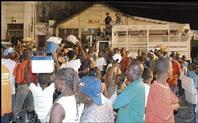
Digicel is aiming to bring telecommunications to ordinary Haitians. Security forces stand guard as Haitians celebrate carnival in 2004 in Port-au-Prince as part of the 200th anniversary celebrations of the revolution which freed them from French rule. - ANDREW SMITH/PHOTOGRAPHY EDITOR
At its huge VIP Haiti launch party overlooking Port au Prince on Wednesday night, Digicel's founder, billionaire entrepreneur Denis O'Brien, told the more than one thousand leading members of the Haitian business community (a significant portion of whom were now Digicel dealers) that Haiti and the Caribbean were "One of the most entrepreneurial regions in the world and we hope that Digicel's entry into Haiti is helping to position the country as a good place to invest in business and that we will see other corporations following our example." Asked why he had invested in 'risky' Haiti, Mr. O'Brien added that when he first came to Haiti two years ago, everybody was 'buying and selling - it was like a bazaar'. But he believed the market opportunity outweighed the macroeconomic risks, and believed that with Digicel's arrival the 'foreign investment community is waking up to the opportunity.'
Mr. O'Brien announced that due to the 'avalanche' of support for Digicel's GSM network, he had decided to increase his initial investment of US$130 million by another US$50 million over the next few months. Stating that, "he had never seen a market like it" he argued Digicel's success had been so great that soon the interconnection issue with their competition would become irrelevant as Haitians were just throwing away their other phones.
In an after party interview, he complimented his Jamaican staff, who he said had 'successfully transferred the DNA of the company to Haiti,' stating that it was the extremely warm welcome that Jamaica had given Digicel that had determined their decision to headquarter their operation here. He agreed with a Haitian journalist that Jamaica's 'Rising Stars' should be brought to Haiti, in view of the country's strong musical culture.