RUDOLPH BROWN/CHIEF PHOTOGRAPHER
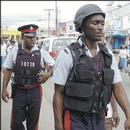
Policemen patrol the streets of May Pen, Clarendon.
Stephanie Elliot, Gleaner Writer
CLARENDON:
WITH ONLY seven days gone in the year, there are signs that criminal activities in Clarendon will continue unabated for the rest of the year. So far, one man has been murdered and two seriously injured in a drive-by shooting, allegedly drug-related.
On January 2, the parish's first murder was committed. Robert Harrison, a 27-year-old farmer, of Kemps Hill, was fatally shot and two others hospitalised in serious condition. Two other men, Franklyn Waugh, and Jamaro Charoo, son of Randolph Charoo, councillor for the Kemps Hill division, were also shot and injured during the incident.
Police reports say the men were at a shop in the community at approximately 9:30 that night when four armed men drove up in a motor car and opened fire, hitting all three. Harrison died immediately, while Waugh and Charoo were rushed to hospital, where they have since undergone surgery.
DRUG DEAL GONE BAD
Corporal Cornel Stewart, CCN liaison officer for Clarendon, in an official police report, said the incident was the result of a drug deal gone awry. He explained that intelligence gathered by the police indicates that the killers had returned to the area after substance, believed to be cocaine, purchased the previous day, turned out to be flour. A feud subsequently developed over the fake drug.
Despite the police's allegation that Charoo was directly involved in the selling of flour for cocaine, the claim has been refuted by residents of the community and by his father. According to the elder Charoo, his son was just an innocent bystander, as were the other men. Unable to give much information, Mr. Charoo said that he knew of the practice of selling flour for cocaine in the parish's southern belt. "What we need to do is to try and flush out these persons and then innocent people won't be caught up in situations like this," he said.
INTER-PARISH MIGRATION
Other shooting incidents have brought inter-parish migration and its consequences, as they relate to crime, into question by the police and the business community. Residents are concerned about outsiders moving into the parish to set up squatter communities. Just last week, a minister of religion went to his property and gave warnings to several informal settlers to vacate his land. He was shot in his arm by unknown persons who ambushed him.
Aldo Brown, president of the Clarendon Chamber of Com-merce, in a recent interview with The Gleaner, said there was a need for the 'capture land' mentality to be abandoned. Citing the capturing of land as a dangerous practice, Mr. Brown said these areas are usually transformed into garrison-like communities.
The chamber president said he would liaise with the relevant government agencies in the monitoring of these settlements. He also expressed his intention to step in and take action against persons who try to set up such illegal living arrangements. Mr. Brown had made an observation of the geographical location often chosen by 'squatters' to set up their homes and said the practice needed to be discouraged. "Persons are building houses near gullies and in other dangerous areas. This cannot continue," he said.
There is also the matter of gun smuggling from Haiti into the island through Clarendon connections. Information of guns being smuggled into the country by Haitian nationals has taken a new twist. The Clarendon police have in their custody a Haitian couple believed to be linked to the trade, sources have disclosed.
HAITIANS ARRESTED
According to police reports, last week Friday, the police, acting on intelligence, went to Guts River beach and after observing certain activities, arrested two Haitian nationals - a man and a woman. It has been confirmed that they arrived in the island on boat, but their identities are yet to be revealed.
Cleon Marsh, crime chief for the parish, confirmed recently, the smuggling of guns into the parish by Haitian nationals. He also disclosed that fishermen are involved in the practice. Marsh indicated that intelligence had led them to believe that it was a gun-for-ganja trade.