REUTERS
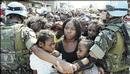
Brazilian U.N. peacekeepers hold back Haitians during an aid distribution in the neighbourhood of Bel-Air in Port-au-Prince, Haiti, last year. Haiti has again postponed the election which was scheduled for today because of problems distributing voter cards, recruiting workers and locating polling stations.Robert Buddan, Contributor
HAITI WAS supposed to have had elections today. They have once again been postponed. Haiti is the oldest black republic in the hemisphere and the poorest.
Bolivia held elections on December 18. Bolivia has the largest indigenous Indian population in the hemisphere. It is the poorest South American country and the second poorest in the hemisphere after Haiti. Evo Morales, the newly-elected President of Bolivia, has declared that his country was entering a millennium for the people, not of the old empires.
Morales is the first indigenous Indian to become President of his country. He feels a special antipathy towards the colonial empires because Indians have come out worse than any other group in the Americas. The poorest and most discriminated people in the hemisphere are not blacks, but indigenous Indians.
The United States, Canada and France, the active interventionist powers in Haiti, represent the ways of those old empires. Between them they have failed to make Haiti better and have failed on four occasions to hold democratic elections since forcing Aristide from power a year ago. Haiti still cannot produce a leader who can declare a new Millennium for the people of Haiti.
BOLIVIA'S NEW MILLENNIUM
Morales' millennium for the Bolivian people finds common cause with Hugo Chavez, himself of mixed Indian blood and they oppose the free market integration schemes of the United States. Morales has another grouse against the empires. Bolivia had long been ruled by a repressive military aided and abetted by the United States, like Haiti has had. Recently emerging from authoritarianism, the Bolivian people have been able to exercise the first political victory of Indians since Columbus landed in the New World and justifiably, have done so in the most populous Indian country in the hemisphere. An Inca is once again leader of his country.
Bolivia shares some important similarities with Venezuela. The rich have captured its enormous wealth of oil and natural gas. Venezuela is the fifth largest oil producer in the world and it is only since Chavez has come to power that the poor are getting the benefits of health and education from its oil revenues. Bolivia sits on top of one of the major oil and gas reserves in South America. Morales hopes to bring the same benefits to his people through the Bolivarian Alternative of the Americas.
NATURAL HISTORICAL ALLIES
These two countries make natural historical allies. Simon Bolivar, the visionary liberator who hoped for a united states of South America, was a Venezuelan who led the liberation of Bolivia, which was named in his honour. Chavez has now named his country the Bolivarian Republic of Venezuela.
Chavez will now work with Bolivia to eradicate illiteracy in 30 months, nationalise its natural gas industry, and pursue land reforms. With these rich oil and gas industries and social mobilisation with help from Venezuela and Cuba, Bolivia is indeed in a position to declare a millennium for the people.
What happens in Bolivia might seem distant from what is happening here. This past week we heard that a US$300 million low-interest loan from Venezuela will now make it cheaper for us to complete HIGHWAY 2000 and might even make it possible to reduce proposed toll rates for some sections. Put another way, the Venezuelan loan makes it possible to fund three-quarters of one of the most important national projects in the history of Jamaica at rates not available on any other market. If Bolivia sits on major reserves of oil and gas, it too can contribute enormously to ALBA's plans to fight poverty in the hemisphere.
In Bolivia, 60 per cent of the population is indigenous, the largest indigenous population in any country. However, two-thirds of the indigenous people live below the poverty line. Bolivia has the second richest reserves of natural gas in South America yet it is the poorest country in South America and the second poorest in the hemisphere after Haiti. The major political issue of recent years has been about exerting more national control over the oil and gas industry and getting more benefit from revenues. Bolivians did not benefit from the oil price bonanza of 2005, a fact that made candidates like Morales popular because of his plans for nationalisation.
Morales' victory is also a victory for Cuban revolutionary, Che Guevara. It was to Bolivia that Che Guevara went in 1965 to lead the next modern revolution in the hemisphere but he was hunted and shot down by the Central Intelligence Agency (CIA) of the United States of America in 1967. The country was subjected to military rule for many years after and then to neo-liberal free market orthodoxy. Morales, Chavez and Castro now have the opportunity to make Guevara's revolutionary sacrifice bear fruit so many years after.
HAITI AND OLD EMPIRES
Haiti was to have held elections today. Haiti represents the western model. The richest countries in the hemisphere overthrew a popularly elected president a year ago and have failed to offer either revolution or election. They have exiled the elected president, jailed his likely successor, and have failed to meet four deadlines to elect a new president. Haiti is not in a position to declare that it has entered a Millennium for the people. It is still trapped in the Millennium of empire.
The empires are inept ones. The United States has failed to complete a war in Iraq after declaring years ago that it had won. The French, who gave us the Rights of Man seemed to have forgotten that (immigrant) women have rights too and immigrant men count as well, leading to its worse race and immigration riots in decades a few months ago. The Canadians have no government now. Their minority government has fallen because of charges of corruption. How on earth can countries like these guide others like Haiti towards democracy and development?
Haiti needs a revolution. In Haiti, a few hundred families own 90 per cent of the country's wealth. Probably Haiti's revolution lies with ALBA's Compensatory Fund for Structural Convergence, not a very revolutionary name, but the kind of mechanism that would fund anti-poverty and development programmes.
Haiti's revolution would need more than compensatory financial facilities. It will require a different way of organising power in society. ALBA stresses indigenous solutions and it is to this tradition that Bolivia will turn. For example, Morales will be sworn in according to two different ceremonies - the constitutional one, and the indigenous folk tradition. Indigenous solutions rely on local custom and local participation. This is what Aristide attempted but his country was starved of funds as the International Monetary Fund (IMF) insisted on its model. But ALBA points out that development cannot be dependent in the long run on other countries. Countries can work together to lay the basis for development but they must become self-sustainable eventually.
REAL MEANING
There is a real meaning behind the term, 'Millennium for People'. First it seeks to replace the older Millennia of nineteen and twentieth century dominance by Europe and the United States with a 21st century integration of the hemisphere. Within this integration of countries it seeks to create a social state in the interest of people, not of elites. Ultimately, it seeks the elimination of poverty. Bolivia now has a chance. When will Haiti get its own?
Email the Department of Government at: Robert.Buddan@uwimona.edu.jm.